Most people skip leg day because they’re not sure where to start. The movements feel technical, the soreness afterward is legendary, and the gym floor is confusing when you’re new to it. This plan introduces the 6 exercises that matter most for beginner leg workouts, how to run them twice a week, and what the first few weeks actually feel like. Every 10 Fitness location has the equipment to follow it from day one.
Jump to what you need:
- Why leg day is worth prioritizing
- The exercises to know before you start
- The beginner plan
- How to pick your starting weight
- What to expect after your first session
- Find a 10 Fitness near you
- Common questions answered
Why Leg Day Deserves a Spot in Your Weekly Routine
Think about the last time you hauled groceries up a flight of stairs without stopping to catch your breath. Or got up off the floor after wrestling with a toddler or a dog. Or just stood at a kitchen counter for an hour without your back complaining. Those are leg day wins. You don’t see them coming. You just notice one day that stuff feels easier.
Compound movements like squats and lunges recruit your quads, hamstrings, glutes, and core at the same time, not in sequence. Your body has to figure out how to coordinate all of that together, and it works harder because of it. That coordination is exactly what makes a structured beginner leg workout routine so effective early on. More muscles engaged at once means more happens, faster, than anything you’d get from isolated machine work.
Sore knees after a long day on your feet. Hips that complain when you stand up from a chair. That’s what happens when the muscles around your joints aren’t doing their share of the work. Joints aren’t built to absorb impact alone. When the surrounding muscle isn’t there to help, the load goes somewhere, and over years that adds up. Building leg strength now is one of the few things you can do in the gym that actually changes how your body holds up outside it.
What people don’t expect are the quieter shifts. More energy on an ordinary Tuesday. Standing taller without coaching yourself to. A kind of ease in your own body that’s hard to name but easy to feel. It’s not about what you look like. It’s about your body keeping up with your life instead of slowing it down. That part catches people by surprise every time.
Our guide to gym workouts for beginners covers the full floor if you want a bigger picture of where to start. When you’re ready to zero in on your legs, the six exercises below are exactly where to begin.
The Best Beginner Leg Exercises to Know
Six moves, the whole lower body covered. Before you chase heavier weight, run through each one slow enough that you can feel what’s working.
Goblet squat. Hold a dumbbell or kettlebell at your chest, keep your chest tall, and lower down until your thighs are roughly parallel to the floor. New members try this one first for a reason: it teaches you how to squat with weight before anything gets complicated. Your quads, glutes, and core are all working at once.
Romanian deadlift (RDL). This one is all about the hinge. Soften your knees, push your hips back, and let the weight slide down your legs until you feel a pull in the back of your thighs. Then drive your hips forward to stand back up. The slow part, on the way down, is where your hamstrings and glutes actually get stronger. Don’t rush it.
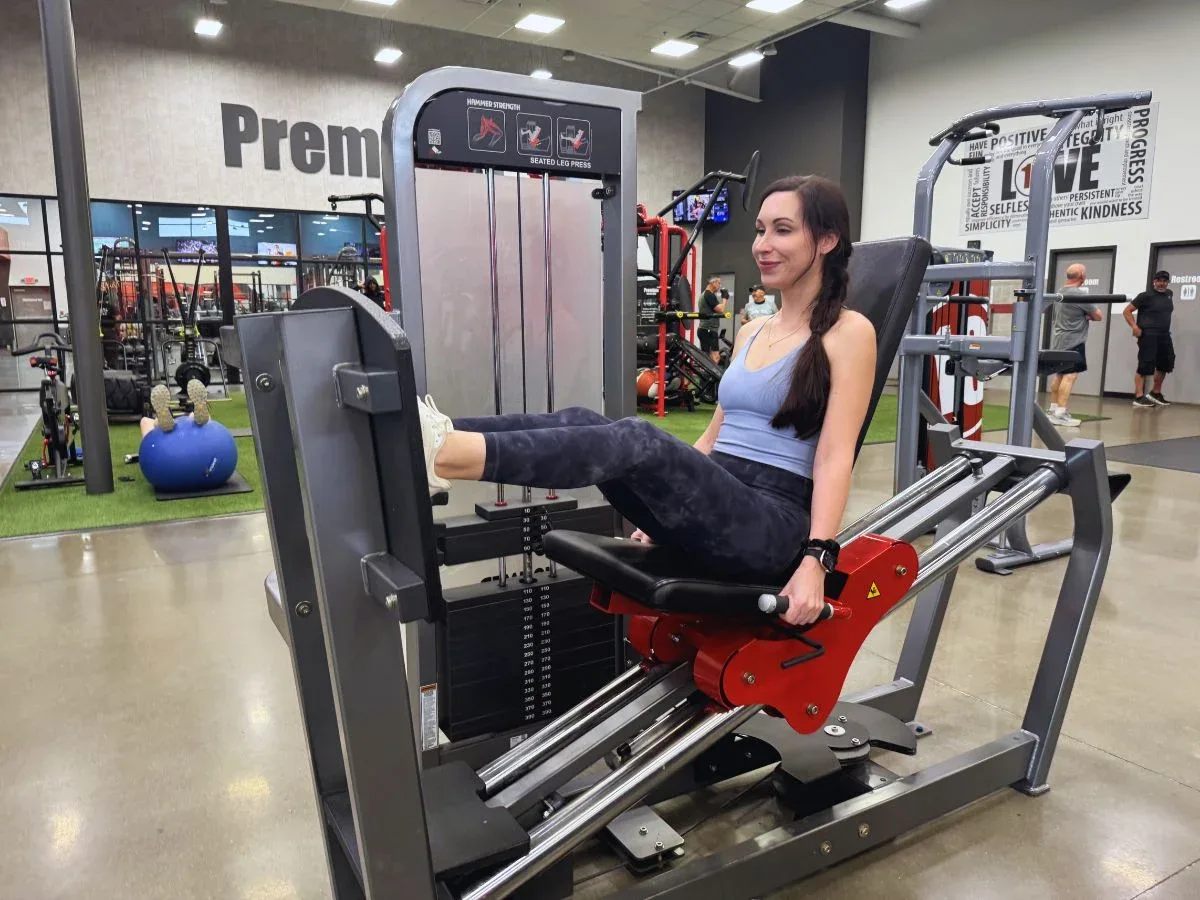
Leg press machine. Sit down, load the weight, push. The machine handles the balance for you, so you can focus on how your legs feel under load. It’s a great way to build confidence in your quads, hamstrings, and glutes before you take those same muscles into free-weight territory.
Walking lunge. Step forward, lower your back knee toward the floor, stand back up, repeat. Because your legs are working independently of each other, you’ll notice pretty quickly if one side is doing more than its share. That’s useful information early on.
Leg curl machine. Your hamstrings don’t always get enough direct work from squats and presses alone. This machine targets them specifically: you lie down, curl your heels toward your glutes, and lower back with control. Short movement, real results for the back of your thighs.
Calf raise. Stand tall, push up onto your toes, lower back down slowly. That’s it. Your calves support every step, every squat, every time you’re on your feet, and most beginners skip them entirely. Don’t.
A Beginner Leg Workout You Can Start This Week
Aim to run this workout twice a week. Give yourself at least two full days off between sessions so your legs can recover and come back stronger.
Start with five minutes of easy movement before you lift. A treadmill walk or a slow spin on the stationary bike gets blood flowing to your legs and helps keep you from getting hurt.
| Exercise | Sets | Reps | Rest |
|---|---|---|---|
| Goblet squat | 3 | 8-12 | 60 sec |
| Romanian deadlift | 3 | 8-12 | 60 sec |
| Leg press | 3 | 10-12 | 60 sec |
| Walking lunge | 3 | 10 each leg | 60 sec |
| Leg curl | 3 | 10-12 | 60 sec |
| Calf raise | 3 | 12-15 | 45 sec |
Progression rule: When you can finish all your reps with clean form in two workouts back to back, bump the weight up slightly. Five pounds on a machine, one dumbbell size up. Slow, steady progress is real progress.
Your glutes are one of the biggest and most important muscle groups in your lower body, and this plan trains them through squats, RDLs, leg press, and lunges. If you want to give your glutes more dedicated attention outside of leg day, our beginner glute workout is a solid companion plan.
How to Pick the Right Starting Weight for Leg Exercises
Here’s the thing: your legs aren’t starting from scratch. Every stair you’ve ever climbed, every time you’ve stood up from a chair or hauled groceries inside, that’s all been loading your legs for years. So no, you’re not as weak as you might think.
A good rule of thumb is to find a weight you can lift for 10 reps with clean form, where the last two reps feel hard but not desperate. Rep 8 shouldn’t be a grind. If it is, go lighter.
Starting light isn’t playing it safe. It’s just smart. You’re learning how the movement actually feels before you pile on load. There’s a difference.
Goblet squat: Grab a 10 to 20 lb dumbbell and focus on depth and keeping your chest up. The number on the weight genuinely doesn’t matter here.
Leg press: Most people can handle more than they expect on this one. The machine guides the path and takes balance out of the equation, so you get to focus on effort instead of coordination. Load it up a little more confidently than you would on a freestanding movement.
Romanian deadlift: Start in the 15 to 25 lb range with dumbbells. The hip hinge is a skill you’re building, not just a movement you’re doing. Learning it well with lighter weight pays off more than you’d think.
Once a weight starts to feel comfortable across all your sets, add a little more the following session. That’s it. Small increases are what actually build strength over time. Our strength training for beginners goes deeper on progressive overload and how to keep moving forward.
What to Expect After Your First Leg Workout
Here’s something no one warns beginners about: the soreness doesn’t show up right away.
According to Cleveland Clinic, delayed onset muscle soreness (DOMS) develops 24 to 48 hours after your workout, not immediately after. It peaks around the 48-hour mark, then fades over the next few days. So if you walk out of the gym feeling totally fine, that’s not a sign you went easy. The soreness is just warming up.
What’s happening underneath is actually pretty cool. Leg training creates tiny tears in your muscle fibers, and your body patches them back stronger than they were before. That achiness you feel isn’t damage. It’s adaptation. It means the workout did exactly what it was supposed to do.
For true beginners, that first DOMS can hit harder than expected. Stairs might become an event.
Here’s what actually helps: keep moving. A short walk or some gentle stretching does more for recovery than lying still. If you want to stay active, an upper-body session the next day lets your legs rest while you keep momentum going. Foam rolling helps move blood through tight tissue and can take the edge off. Drink water, eat enough protein, and give your body what it needs to do the repair work. Per NASM, beginners should aim for 48 to 72 hours between leg sessions. On those off days, core workouts for beginners are a smart way to stay moving without loading your legs again.
The good news: it gets easier. Your second leg day recovery will feel noticeably better than your first. Your body is already figuring this out.
Build Your Leg Day Strength at 10 Fitness Cantrell
10 Fitness Cantrell is 10 Fitness’s west Little Rock location, built around dedicated strength and cardio zones that make sense for a beginner navigating the gym floor for the first time. You get 24/7 access, so you can train at 6 a.m., lunch, or 10 p.m. without rearranging your week around posted hours. A second west side location is coming to Bowman Road in 2026, adding even more access across that part of the city. Find a 10 Fitness near you to see all available clubs across Central Arkansas and beyond.
If you want someone to walk you through the movements on day one, a 10 Fitness Nationally Certified Personal Trainer can check your form and build a plan around where you’re starting. Book a session through 10 Fitness Personal Training.
Questions Our Trainers Hear Most
How often should I do leg workouts as a beginner?
Two days a week, 48 hours apart. That gap matters because your muscles actually grow during recovery, not during the workout itself. A couple months of that rhythm and you’ll know if you’re ready to add a third day.
Will leg workouts make my legs bulky?
Short answer: they won’t. Real muscle bulk requires months of deliberate, progressive training stacked on top of dialed-in nutrition. It’s not something that sneaks up on you. What actually happens for most beginners is the opposite: three or four months in, they’re leaner, feel stronger, and can do things they couldn’t before. The "bulky" fear almost never plays out.
What if my legs are sore after my first workout?
Yep. Expect it around 48 hours after. Keep moving anyway: a walk or an easy upper body session will clear it faster than resting completely.
Ready to Try Your First Leg Workout?
Your first leg day doesn’t need to be perfect. Pick two days this week, run through the plan at your own pace, and pay attention to how your body responds. Find a 10 Fitness near you and show up.