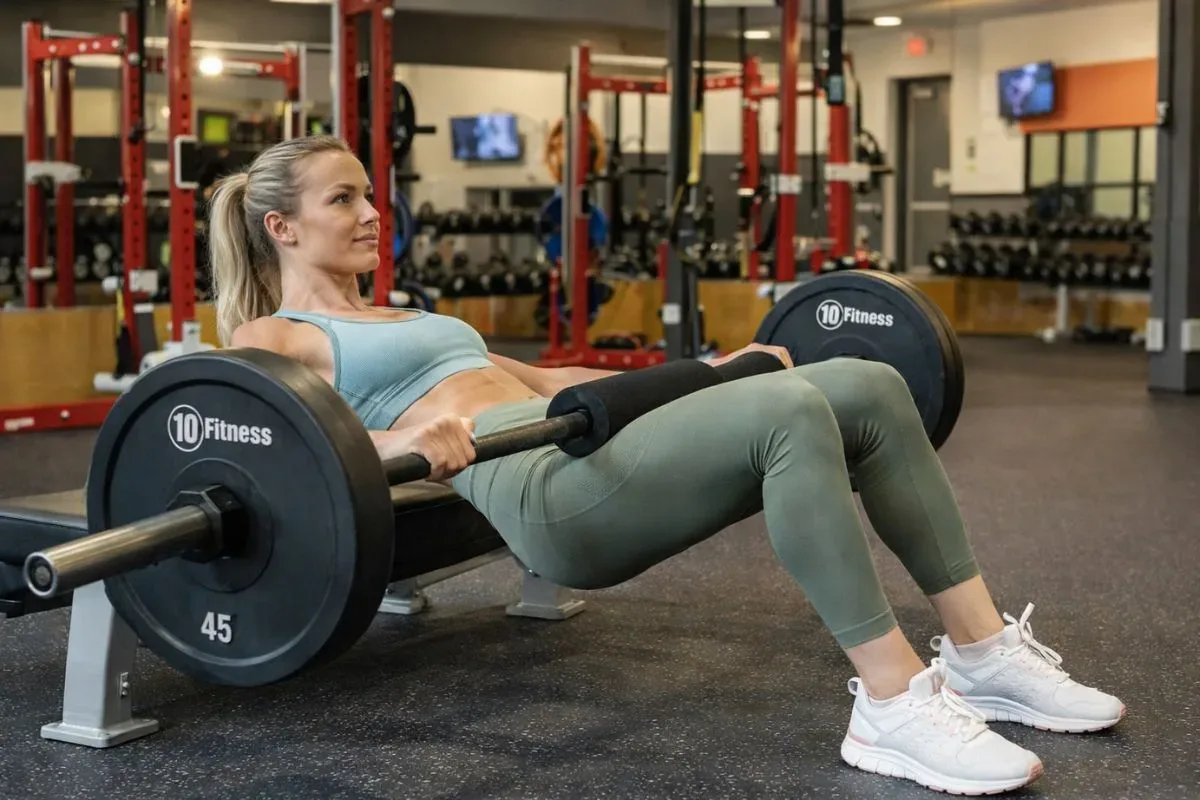
Most people starting out spend way too long deciding where to begin. If that is you, start with your glutes. Two or three sessions a week built around bridges, squats, hip thrusts, and lunges can build a useful strength foundation. No equipment is needed at first. When you are ready to add resistance, use a gym setup that lets you practice at your own pace.
How Often Should Beginners Train Glutes?
Most beginners can start with two focused glute sessions each week, leaving at least one rest day between sessions. Begin with bodyweight movements, use a controlled range of motion, and add repetitions or light resistance only when your form stays consistent. A simple two-day structure is: Day 1, bridges, squats, and reverse lunges; Day 2, hip hinges, step-ups, and side-lying leg raises. Adjust the exercise choice to your experience and stop if a movement causes pain.
For broader strength-training basics, read our strength training for beginners guide. When you are ready to train with equipment, find a 10 Fitness gym near you.
Key Takeaways
- Your glutes are your body’s most powerful muscle group. Training them can support everyday movement and strength when paired with consistent practice.
- Beginners should train glutes 2-3 times per week with at least 48 hours of rest between sessions for optimal recovery and growth.
- Start with bodyweight exercises like glute bridges, squats, and hip thrusts. No equipment required to get results.
- The mind-muscle connection is the biggest beginner gap. Consciously squeeze your glutes at the top of each rep to maximize muscle activation.
- Progressive overload means increasing reps before adding weight. It’s the key to steady, sustainable beginner results.
- Consistency over intensity: two focused sessions per week, done regularly, will outperform sporadic hard sessions every time.
- Recovery is part of the program. Rest days, quality sleep, and post-workout stretching are not optional extras.
Jump to a section:
You Don’t Have to Know Everything to Get Started
Nobody walks into a gym with a perfect plan. Nobody. And honestly, starting with glutes is one of the better decisions you can make as a beginner, not because of how they look (though that comes too), but because they’re already working hard whether you train them or not.
Think about what you did this morning. Got off the couch. Took some stairs. Hauled the groceries inside in one trip because two trips felt like giving up. Your glutes were doing most of that. You might as well give them some intentional attention.
Most people only think about the big one, and honestly that makes sense. The gluteus maximus, gluteus medius, and gluteus minimus do very different jobs, but you rarely feel the difference until something’s off. If your lower back aches after a long day standing, or one hip dips when you walk up stairs, that’s usually the medius, the muscle on the outer hip that nobody trains on purpose. It just gets ignored. The minimus sits underneath it, deeper, handling rotation and keeping the joint from shifting around. Three muscles per side, six total, and the maximus, that big powerful one, gets all the credit while the other two quietly fall behind.
Glute strength supports controlled hip movement and everyday activities. If you feel persistent pain, stop the exercise and seek guidance from an appropriate health professional.
10 Fitness Bryant has the setup to take you from bodyweight basics all the way to loaded movements, at your own pace. If you’re coming from south of I-30, it’s close. Good spot to make this a regular habit.
Want a broader framework before diving into specific exercises? This beginner gym workout routine lays out the full picture. Otherwise, let’s get into the actual work.
Beginner Glute Workouts for Women
Shape and lift bring a lot of women to glute training. Some come for the functional side of it, strength they can actually feel day to day. Either reason holds up, and most people end up with both once they’re consistent.
The aesthetic results are genuine. Glute training builds a rounder, fuller shape over time, and you start noticing it in small ways first. How your jeans fit through the seat. How a dress sits differently. Walking into swimsuit season and actually feeling good about it. That’s not accidental. It’s the result of showing up two or three times a week and putting in the work.
And look, part of it is just that it feels good to see something working. That’s not shallow, that’s real. Women who train their glutes consistently almost always bring up the same thing: they start standing differently, moving differently, taking up a little more space. It’s hard to separate that from the physical stuff because they happen at the same time. But either way, if you want a place to put your energy, this is a solid one.
Beginner Glute Workouts for Men
Here’s the practical case for glute training if you’re a guy: everything else in the gym gets better when your glutes are strong. Your squat numbers go up. Your deadlift feels more controlled. Any sport you care about, sprinting, jumping, cutting direction, involves your glutes whether you’ve trained them or not.
They also protect you. Weak glutes shift load to the lower back and knees, which is where most men eventually run into nagging injuries. Training them directly is one of the simpler ways to stay out of that cycle.
One more thing worth mentioning, especially if you spend most of the day at a desk. A lot of guys develop anterior pelvic tilt without realizing it: the hips tip forward, the lower back strains, and the backside flattens out. Direct glute work helps correct it, pulls the hips back into alignment, and improves how you stand and move. On the physique side, developed glutes fill out an athletic build in a way that’s genuinely hard to fake. Strong from every angle, not just from the front.
What Are the Best Beginner Glute Exercises?
Four exercises are all you need to start: bridges, squats, hip thrusts, and reverse lunges. No gym required, no special equipment, no experience necessary. These movements actually build glute strength, they’re forgiving enough to learn from zero, and you can keep progressing with them for months.
Glute Bridges
Lie on your back with your knees bent and feet hip-width apart. Press your heels into the floor and lift your hips until your shoulders, hips, and knees form one straight line. Hold for a full beat at the top. Then lower down slowly and with control.
Beginner tip: Watch your knees the whole way up. They’ll want to collapse inward, and your job is to push back against that on every single rep.
Bodyweight Squats
Stand with feet about shoulder-width apart, toes pointed slightly outward. Think of reaching back for a chair that’s just a little too far behind you. Chest up, weight in your heels. Lower as far as you can control, then stand up strong.
Most beginners lose their heels. If yours are coming off the floor, your ankle flexibility isn’t quite there yet, and that’s fine. Shorten the range. Meet your body where it actually is right now, not where you think it should be.
Hip Thrusts (Using a Bench or Couch)
Don’t skip this one. Sit on the floor with your upper back resting against a bench or couch, knees bent, feet flat. Drive your hips up until your torso is parallel to the floor. At the top, actually squeeze. Hard. That moment of intentional contraction is the whole point of the exercise.
Research confirms that hip thrusts produce among the highest glute muscle activation of any lower-body exercise, and both squats and hip thrusts have been shown to produce similar results in beginners. So you’re doing both. They serve each other.
The setup takes getting used to. Give it a few sessions before you judge it.
Beginner tip: Stop when your torso is parallel to the floor. Go past that and your lower back starts doing the work instead of your glutes.
Reverse Lunges
Stand tall. Step one foot back and drop that back knee toward the floor. Front knee stays stacked over your ankle, not past your toes. Then drive through your front heel to stand, bring your feet together, and switch sides.
Wobbly is fine. Put a hand on the wall or grab a chair back. Your stabilizers just need time to catch up. Let them.
A Note on Mind-Muscle Connection
Your quads will show up. Your hamstrings will chip in. Your glutes, though, will quietly step back and let everyone else handle it, unless you make them engage on purpose.
A lot of people add reps thinking more is the fix, but the glutes just keep sleeping through it. What actually changes things is getting deliberate. Before you even move, think about where you want to feel it. At the top of every bridge and hip thrust, hold the squeeze for a full second, a real one, not just a brief pause. It sounds minor, but it’s doing something specific: you’re training your nervous system to actually recruit that muscle instead of defaulting to your hamstrings or lower back. Keep doing it, and eventually it stops being something you have to think about. That’s when you start waking up sore in exactly the right place.
How Do I Know My Glutes Are Actually Working?
The work should sit in your glutes, not your lower back. At the top of each rep, that squeeze should feel intentional, like you’re actively firing the muscle rather than just holding a position and counting the seconds.
Lower back taking over? Reset your foot position, push harder through your heels, and make sure you’re getting a real glute contraction before you lower down. Try a couple reps with that focus. You’ll feel the shift.
For more on getting comfortable in a gym setting, gym workouts for beginners is a solid place to start. Up next: how to turn these exercises into a routine that actually holds up week to week.
How to Structure Your Beginner Glute Workout Routine
Two or three sessions a week. That’s your whole target right now. Not five, not daily. Research confirms muscles rebuild and strengthen during recovery, not during the workout itself. The rest between sessions isn’t downtime. It’s the work. Skip enough of it and you stop progressing, or you break down altogether.
Most beginner programs don’t fail on exercise selection. They fail because nobody explains the reasoning behind the structure. So when Thursday disappears and you miss a session, you don’t know what to do. Double up Friday? Skip it and reset Monday? When you understand why the program is built the way it is, those decisions stop feeling like crises.
Start with Bodyweight, Then Build
Start every new movement with just your bodyweight. That’s not because you’re a beginner. That’s because coordination has to come before load, every time. Take the glute bridge. If your hips are tilting or your lower back is pulling during a bodyweight rep, adding a dumbbell won’t fix that. It’ll just make the problem heavier.
Get your reps feeling controlled across all your sets, not just the first one. Once that’s consistent, add a few more reps. Once that’s solid, bring in light resistance. That sequence is progressive overload. Sounds technical, but it just means asking a little more of your body over time, at a pace it can actually keep up with.
How Heavy Should I Start?
Bodyweight only at the start. Lots of people want to grab a band or a light weight on day one, and the instinct makes sense, but loading a movement before it feels natural usually means you’re just reinforcing a shaky pattern with more weight behind it. Feel it in your glutes first. Every rep, every set. Then add resistance and go from there.
A Simple Beginner Glute Workout Plan
Before you stress about the program itself, here’s the good news: you don’t need much. A little floor space, a bench, and basic equipment, that’s it. This routine was designed to work at any 10 Fitness club without hunting for specialty machines or waiting on equipment. Three exercises, two or three days a week, and the whole thing takes less time than most people spend warming up. Simple on purpose.
| Exercise | Sets | Reps |
|---|---|---|
| Glute bridges | 3 | 15 |
| Bodyweight squats | 3 | 12 |
| Reverse lunges | 3 | 10 each leg |
Rest 60 to 90 seconds between sets. You’re looking at 20 to 25 minutes total.
Run it as straight sets or move through it as a circuit. Pick whichever format actually keeps you moving. Both work.
After your first couple sessions, expect soreness. It usually peaks around 24 to 48 hours out, then backs off as your body adapts. Completely normal. Don’t let it convince you to skip your next session.
This routine fits well alongside broader workout plans for beginners, and it pairs naturally with a full body weight loss workout for beginners if you want to fill out the rest of your week. Two or three sessions is genuinely enough to start seeing results, as long as you actually show up for them.
How Do You Get Real Results From Glute Training?
Walk through any gym, and you’ll see people doing the right exercises, then going home and sleeping four hours, skipping meals, and wondering why nothing is changing after six weeks. That’s usually the whole story. The exercises aren’t the problem. It’s everything built around them: how often you actually show up, whether you’re recovering between sessions, whether you’re eating enough to support the work you’re putting in. That stuff isn’t exciting to talk about, but it’s almost always what’s actually in the way.
Warm up before you load anything. Glutes are notoriously quiet when they haven’t been activated. Cold, they check out fast and let your quads take over before you’ve even noticed. Five to ten minutes of bodyweight bridges or clamshells, or running through a full body stretching routine, before you pick up anything heavy isn’t optional. It’s what gets your nervous system talking to the right muscles. Skip it consistently, and you’ll keep wondering why every lower-body session feels like a quad workout.
Two or three sessions a week beats one session that wrecks you. Waking up sore two days after a solid workout is normal. That’s your body adapting. But if your joints feel sharp or you genuinely can’t walk right the next morning, that’s a different signal. That’s too much, too soon. The habit of showing up regularly matters more than any single brutal session, now and really at any point.
Glute training pairs well with strength training for fat loss and core workouts for beginners. Build those habits at the same time, and you’re laying a real foundation, not just checking boxes.
Recovery isn’t a reward for hard work. It’s part of the work. Muscles break down during training and rebuild during sleep and rest. Foam rolling, stretching, using the massage chairs after a tough leg session. We watch members at 10 Fitness skip all of it, and it always catches up with them eventually. Those recovery amenities exist because they actually help. Use them.
Common Beginner Glute Workout Mistakes
Four mistakes show up constantly with newer members. None of them are hard to understand. They’re just easy to fall into when you want results and you’re pushing to get there fast.
- Going too heavy too soon. Form breaks down quickly, and once it does, your glutes check out and other muscles compensate.
- Arching your lower back during hip thrusts. That arch shifts the load off your glutes and onto your spine, which isn’t what we’re going for.
- Rushing through reps. Slower, more controlled movement creates more tension in the muscle. That tension is what drives results.
- Skipping rest days. The workout breaks the muscle down. Rest is where it actually grows.
Bryant isn’t the only option. 10 Fitness has clubs across Central Arkansas, including Little Rock, North Little Rock, Conway, Maumelle, Cabot, and a Bowman location coming in 2026. Find your nearest gym and start at whichever one makes it easiest to walk in the door.
10 Fitness Bryant is a natural fit if you’re in Bryant or Benton. But pick the location with the least friction. That’s the one you’ll actually go back to.
Beginner Glute Workouts Near You in Bryant
Bryant and Benton folks, this one’s for you. 10 Fitness is genuinely one of the more beginner-friendly setups in the area for lower-body work. The club has an upgraded functional area, premium free weights, and Level 10 Team Training, so there’s plenty of room to learn the basics (glute bridges, hip thrust setups, bodyweight squats) without feeling like you walked into a competition. It sits just south of I-30, convenient for both communities. “Fitness for Every Body” is on the wall, but it’s also kind of the whole operating philosophy. That matters when you’re just getting started.
Not near Bryant? That’s the thing about 10 Fitness: it’s built for Central Arkansas, not just one corner of it. Locations in North Little Rock, Conway, Maumelle, Cabot, Cantrell, Jonesboro, Searcy, and beyond mean most folks in Arkansas have one closer than they think, with more on the way in 2026. Find the location nearest you and the same beginner-friendly setup is waiting there too.

Not Sure You’re Doing the Movements Right?
Form is honestly one of the best investments you can make early on. A certified personal trainer can watch what you’re actually doing, not what you think you’re doing, and catch the small habits that turn into bigger problems later. Beginners plateau or develop nagging discomfort a lot more often from poor mechanics than from not working hard enough. The good news is that at 10 Fitness, personal training is available for members at every level. Whether you’re brand new or just want someone to check your hip hinge, you can find a trainer and see what’s available at your location.
Frequently Asked Questions
How long until I see results from beginner glute workouts?
Strength comes first, then shape. The first two or three weeks, your nervous system is learning how to recruit the muscle more efficiently, so you’ll feel like you’re getting stronger before anything looks different in the mirror. Visible changes take longer. Fuller glutes, more definition, that usually shows up somewhere in the six to twelve week range. Depends on consistency, diet, sleep.
Sporadic hard weeks don’t beat boring regularity. They just don’t. Show up consistently, eat enough protein, and the results follow.
Can I do glute workouts every day?
Skip a day between focused glute sessions. Muscle tissue that hasn’t finished rebuilding doesn’t get stronger when you hit it again. It just breaks down more. About 48 hours is what most people need.
Off days don’t have to mean sitting still, though. Walk, do some upper body work, go for a bike ride. Daily movement is genuinely a good habit. Just give the glutes a break before you load them up again.
Why don’t I feel my glutes working during exercises?
Really common. Frustrating, but fixable. When your quads or hamstrings are more ready to work, your body lets them take over without asking your permission. It happens automatically.
Slow down and squeeze hard at the top of every rep. Hold it for a full second before you lower back down. Feels almost too deliberate at first. That’s kind of the point. You’re forcing your nervous system to actually find the glute instead of defaulting to whatever else is available. Give it a few sessions.
Do I need equipment to start?
Bodyweight gets you further than most people expect. Everything in this guide works without a single piece of equipment, and that’s a genuine foundation, not just a workaround for beginners. When bodyweight starts feeling easy, resistance bands or light dumbbells make a natural next step. At 10 Fitness, the full range of equipment is available whenever you’re ready.
What are the best beginner glute workouts near me?
Four movements cover the basics: glute bridges, squats, lunges, hip thrusts. No equipment needed. You can do all of them at home, in a park, wherever.
If you want a dedicated space and someone who can actually look at your form, 10 Fitness Bryant has functional training areas, free weights, and trainers on the floor. Low-pressure environment, good for anyone in Bryant or Benton who’s just getting started.
Should beginners use bodyweight or weights for glute workouts?
Start with bodyweight. A lot of beginners grab dumbbells or load up a barbell and then barely feel anything in their glutes because the mind-muscle connection hasn’t developed yet. Bodyweight lets you slow down, figure out what’s actually firing, and build consistency before adding load to the movement.
Once a squat or hip thrust feels natural and you can genuinely feel your glutes working rather than just your lower back or quads, add a light band or some dumbbells. Getting stronger over time is the actual goal. What you’re lifting on day one doesn’t matter much.
Start Your Glute Journey Today
Starting is genuinely the hardest part, and you’re already past it. The movements here are simple, the equipment requirements are low, and most of what will determine your results is just showing up with some consistency. If you want to train somewhere built for people at every fitness level, 10 Fitness Bryant is worth checking out. Become a member and take it from there.