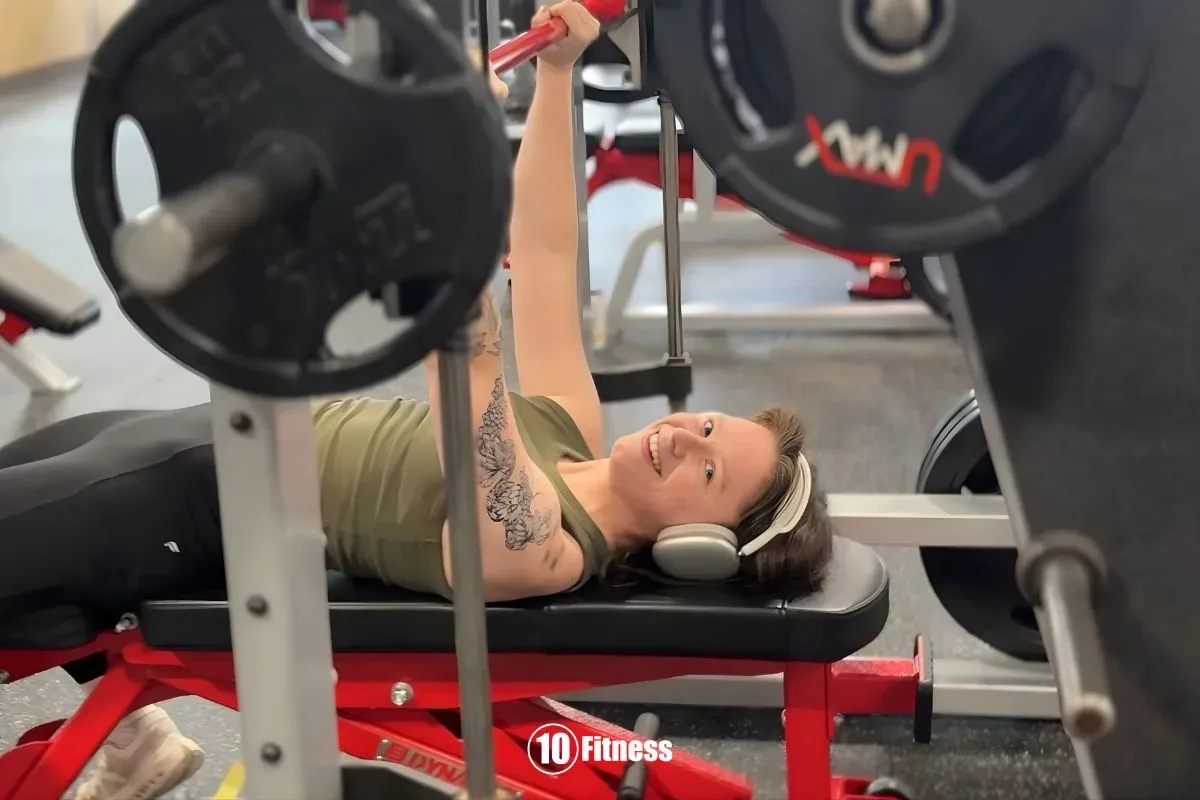
Two sessions a week. A few basic moves. Honestly, that’s it. Beginner chest workouts don’t require a gym background, a spotter, or anything heavier than a pair of dumbbells you can actually lift. Push-ups, dumbbell presses, a couple of machine exercises, and you’re building real upper body strength, which is more than most people ever actually start. This guide covers five beginner-friendly exercises, a simple workout plan, and what recovery looks like so your body can do its job between sessions. Want a supportive place to practice? Find a 10 Fitness gym near you.
Key Takeaways
Jump to: The 5 Best Exercises | How Heavy to Start | The Workout Plan | Recovery Tips | Common Mistakes | Local Gyms | FAQs
That bench area, when you walk in for the first time, kind of feels like someone else’s territory. Like there’s an unspoken rule book and you missed the day they handed it out.
You didn’t miss anything.
Beginner chest workouts are exactly what they sound like: low-equipment, low-pressure stuff that builds real upper body strength without requiring you to already know what you’re doing. That’s kind of the whole point.
Start where you are. That’s it. That’s the whole prerequisite. If you searched for beginner chest workouts near me, this plan is simple enough to use at any 10 Fitness location.
The CDC recommends adults get muscle-strengthening activity at least 2 days per week. Chest training counts. And it’s honestly more forgiving than people expect when they’re just getting started.
A stronger chest does more than fill out a shirt. It helps with posture after a long desk day, makes pushing and carrying feel weirdly easier than it used to, and builds upper body stability that quietly covers for your shoulders and back over time. Benefits that kind of sneak up on you.
But here’s the stuff people don’t always talk about: a lot of people find that sticking with even a simple strength routine pays off in ways they didn’t see coming. Better sleep. More afternoon energy instead of hitting a wall at 3pm. A mood that’s a little more settled. That’s worth showing up for.
So here’s what this covers: which muscles you’re actually training, the five best chest exercises for someone just starting out, how to build them into a simple workout, and what recovery looks like so your body can do its job between sessions.
If you are getting started with strength training for the first time, or just coming back after a long break, read our getting started with strength training guide before you begin.
What Are the Best Beginner Chest Exercises?
Five exercises: push-ups, dumbbell bench press, incline dumbbell press, chest press machine, and dumbbell fly. That’s the list. Full chest coverage, nothing that takes months to learn, and every one of them is something you can actually walk into a gym and do on your first real session.
Look, your chest is mostly one big muscle, but the angle you press from shifts which part of it does the most work (NIH). Flat angles load the whole thing. Incline angles pull the upper portion into it more. Thing is, most beginners never touch incline work and then wonder why their upper chest looks flat compared to their lower. These five exercises cover both angles, which is why the list is exactly this and not something longer.
1. Push-Ups
Start in a plank, hands a little wider than shoulder-width. Lower your chest toward the floor and press back up. Core tight, body in a straight line, no sagging hips.
Don’t sleep on these. Research shows push-ups and bench press produce similar muscle hypertrophy when you’re working at comparable intensity. If full push-ups aren’t happening yet, drop to your knees. Seriously, it’s not a consolation prize. It’s just where you start, and everyone started somewhere.
Lie flat on a bench with a dumbbell in each hand, both at chest height. Press them up until your arms are nearly straight, then lower slowly. Because each arm moves on its own, your body naturally starts correcting small strength imbalances you probably didn’t know you had. One more thing: if all the benches are taken, the chest press machine works great as a swap and you’ll still get a solid workout.
Same motion as the flat press, but you’re set up at a 30 to 45 degree incline. That angle pulls more of the work up into your upper chest, which builds a more balanced foundation over time. If you’re not sure how to adjust the bench, just ask someone. It’s a two-second question and genuinely not a big deal.
Sit, grip the handles at chest height, press forward until your arms extend. The machine keeps you on a fixed path, which means you can stop worrying about balance and actually focus on feeling your chest do the work. ACE research confirms that pressing movements rank among the most effective exercises for chest activation.
5. Dumbbell Fly
Lie on a flat bench, a dumbbell in each hand, arms extended above your chest with a soft bend at the elbow. Open your arms out wide in a slow arc, then bring them back together like you’re hugging a really big barrel. Keep that slight bend in your elbows the whole time so you’re not stressing the joint. This one’s best saved for after your pressing work, not first.
Before you put these together into a routine, you need to know you’re starting with the right weight. So let’s tackle that.
How to Choose the Right Starting Weight
Eight to twelve reps, controlled, where the last two actually make you work. That’s the window. Not easy, not a max effort grind, just honest resistance that your muscles have to respond to.
Here’s what too heavy looks like in practice, because it’s not always obvious when it’s happening to you. Your shoulders start riding up toward your ears. The reps get a little rushed, a little choppy. Your lower back peels off the bench just enough to get the weight moving. That’s your body recruiting muscles that shouldn’t have to be in the conversation at all. When you see any of that, drop weight. Doesn’t matter what the person next to you is pressing.
Too light is easier to catch. You finish twelve reps and honestly could keep going, like there were five or six left in the tank without really trying. That weight isn’t doing much for you. The last rep should cost something, not a fight, not a struggle where your form falls apart, but enough that you actually had to earn it rather than just get through it.
If the free weight bench area feels like a lot when everything is still new, start on the chest press machine. That’s not a fallback. It’s a legitimate way to learn the movement pattern without also having to manage balance and setup at the same time. The nervousness is normal and the machine is a real tool, not a consolation prize.
Your First Beginner Chest Workout
Two days a week. Four exercises. About 20 minutes. That’s it, and it’s genuinely enough to build real strength when you’re just getting started.
Plan for 20 to 25 minutes of actual work, not counting your warm-up. Short enough to fit in a lunch break, long enough to feel it.
The Workout (2 days per week):
| Exercise | Sets | Reps | Rest |
|---|---|---|---|
| Push-ups | 2-3 | 8-12 | 60 sec |
| Dumbbell Bench Press | 2-3 | 10-12 | 60-90 sec |
| Chest Press Machine | 2-3 | 10-12 | 60-90 sec |
| Dumbbell Fly | 2 | 12-15 | 60 sec |
You can run this at any 10 Fitness location. If you’re in Little Rock, 10 Fitness Cantrell has 24/7 access, dedicated strength training zones, and a setup that doesn’t make you feel like you wandered into the wrong place on your first chest day.
Progressive overload doesn’t need a spreadsheet. When the weight you’ve been using feels easy across every set, add 5 pounds. That’s the whole system.
Twice a week is right for beginners. You need at least 48 hours between sessions so your muscles can actually recover. Monday and Thursday works. Tuesday and Friday works. Back-to-back days don’t. Find what fits your schedule, but protect that gap.
In the first session, you’ll probably feel like you should be doing more. You’re not. Trust the plan. You’ll feel it tomorrow. Circuit strength training is a good next step when you’re ready to fold chest work into a full-body routine. If strength training for weight loss is part of why you’re here, chest work fits naturally into that kind of programming too.
Once you’ve got the workout down, the thing that slows most beginners isn’t effort. It’s recovery, and a handful of mistakes that are easy to fix once you know to look for them.
Recovery and What to Expect
Your chest is going to be sore. Not “huh, that’s interesting” sore. We’re talking “why does reaching for my water bottle feel like this” sore.
It usually shows up the next morning. Sometimes the morning after that. That delayed soreness has a name: DOMS, or delayed onset muscle soreness. It peaks around 48 hours in, which means you might feel fine the day after your workout and then wake up on day two genuinely confused about what happened to you.
And here’s the part nobody warns you about: the second workout often hurts more than the first. You’ll show up thinking you already survived the worst of it. Your body will disagree loudly.
Completely normal. New movement, new demand, muscles still sorting it out.
What actually helps:
- Eat enough protein. Your chest muscles are rebuilding right now. Give them something to work with.
- Drink water. Seriously, almost every part of recovery runs on hydration. Not exciting advice. Still true.
- Sleep. The real repair work happens overnight, not during the session. Protect it.
- Move the next day, even a little. A 20-minute walk does more for soreness than the couch does. The couch is very convincing, though.
Before your next session, spend a few minutes with post-workout recovery and stretches for sore muscles. You’ll actually use both.
Common Beginner Chest Workout Mistakes
Most early setbacks trace back to the same handful of habits. None of them are complicated. All of them are worth catching early.
- Going too heavy too soon. Pick a weight that feels almost too easy your first week. Bad form at heavy load builds bad habits fast, and fixing a habit is harder than just starting right.
- Only doing bench press. Bench is the foundation, yes. But it’s not the whole house. Skip incline work and fly movements and you’ll end up with uneven development pretty quickly. Add them from day one.
- Skipping the warm-up. Cold muscles under load is a reliable path to sitting out a few weeks. Five minutes of movement before you lift isn’t a suggestion.
- Training chest every day. Growth doesn’t happen during the workout. The workout is just the signal. Two sessions a week is the correct amount, full stop. Not a beginner limitation you eventually outgrow.
How Often Should Beginners Train Chest?
Twice a week. At least 48 hours apart.
That’s it.
Your chest doesn’t grow in the gym. It grows after, while you’re eating and sleeping and not thinking about the gym. Train again before that window closes, and you’re just loading tissue that hasn’t finished repairing yet. More sessions doesn’t mean faster results. A lot of the time it actually means slower ones.
Pick two days. Put them in your phone. Monday and Thursday works. So does Tuesday and Friday, Wednesday and Saturday, take your pick. But pick something. Winging your schedule every week and never quite knowing when you’re training is how consistency quietly falls apart.
And if you’re still working out the form before you commit to a routine, that’s worth sorting out first. Even one or two sessions with a trainer early on can save you months of practicing a movement pattern that’s been subtly wrong the whole time.
Not Sure You’re Doing the Movements Right?
A lot of people walk into the gym and wing the form. No judgment at all. But there’s a real difference between watching someone do a chest press on your phone and actually having someone watch you do it and tell you what to fix.
A Nationally Certified Personal Trainer can catch things in real time that a video never will. The angle of your elbows. Whether you’re actually engaging your chest or just your shoulders. Little stuff that adds up over months of training. Even one session early on can make everything you do from that point forward a lot more effective.
At 10 Fitness, personal training is set up around where you actually are, not some ideal version of you. Your goals, your starting point, your schedule. If you want a personalized plan and someone in your corner from the beginning, it’s worth asking about. No hard sell, no intimidation. Just someone who knows the movements helping you do them right.
Beginner Chest Workouts Near You in Little Rock
If you’re in Midtown or West Little Rock and looking for a gym that doesn’t feel like you need to already know what you’re doing to walk in, 10 Fitness Cantrell is a solid place to start. There’s 24/7 access, dedicated strength training zones, and genuinely no pressure to have it all figured out on day one. That’s kind of the whole point.
Looking for beginner chest workouts near West Little Rock? 10 Fitness Bowman is now open at 801 S Bowman Rd, Little Rock, AR 72211. The official location page currently lists 24/7 access and a Recovery Room. Check the location page for current details before your visit.

Find a 10 Fitness Near You
You can use this beginner chest workout at any 10 Fitness club, including the now-open West Little Rock Bowman location. Check the official location page for current details before your visit.
Arkansas
Bryant: 1905 N Reynolds Rd, Bryant, AR 72022
Cabot: 204 S Rockwood Dr, Suite G, Cabot, AR 72023
Cantrell (Little Rock): 6823 Cantrell Rd, Little Rock, AR 72207
Conway: 2125 Harkrider St, Conway, AR 72032
Downtown Little Rock: 300 River Market Ave, Little Rock, AR 72201
Jonesboro: 1226 Caraway Rd, Jonesboro, AR 72401
Maumelle: 11731 Maumelle Blvd, North Little Rock, AR 72113
North Little Rock: 6929 JFK Blvd, Suite 110, North Little Rock, AR 72116
Paragould: 121 Medical Dr, Paragould, AR 72450
Searcy: 2205 W Beebe Capps Expressway, Searcy, AR 72143
University (Little Rock): 6221 Colonel Glenn Rd, Suite B, Little Rock, AR 72204
West Conway: 605 Salem Road, Suite 7, Conway, AR 72034
Bowman (West Little Rock): 801 S Bowman Rd, Little Rock, AR 72211
Frequently Asked Questions
How often should beginners do chest workouts?
Twice a week, with at least 48 hours between sessions. Worth noting: the recovery time isn’t just a suggestion. Your muscles are actually doing their growing then, not during the workout itself.
Can beginners do chest workouts at home?
Honestly, more than most people realize. Push-ups get written off constantly, but when your form is solid they’re a real chest exercise, not just a warmup. Throw in a pair of dumbbells and you’ve got a legitimate training foundation without ever touching a barbell. If you’d rather have actual equipment and people around you, search beginner chest workouts near me to find your closest 10 Fitness location.
How long until I see results from chest workouts?
Look, strength changes come faster than the mirror does. Most beginners notice they’re lifting more or bouncing back quicker between sets within three or four weeks. The visible definition? That takes longer. Eight to twelve weeks of actually showing up consistently is the more realistic window. Which brings up the real variable here: it’s not really about which exercises you pick. It’s whether you keep coming back.
Do I need a personal trainer for chest workouts?
No. You can absolutely figure this out on your own. But here’s the thing about getting your form looked at early, even once, even just one session before habits set in: it’s a lot easier to learn a movement right the first time than to spend months unlearning it. If that sounds useful, the 10 Fitness personal training page breaks down what’s available at your club.
You’re a 10 at 10 Fitness: Visit 10 Fitness Cantrell for Your Beginner Chest Workout
Comfort, not cliques. Walk into 10 Fitness Cantrell on any given day and you’ll find people at every stage of the process, some on their first month, some on their third year, all just working. Nobody arrived knowing what they were doing. 10 Fitness is built around that reality, with the community, the coaches, and the equipment to meet you wherever you’re starting from. Come see us.
And if you want a little guidance on getting the movements right, one of our certified trainers can work with you directly through personalized personal training designed around your actual goals.