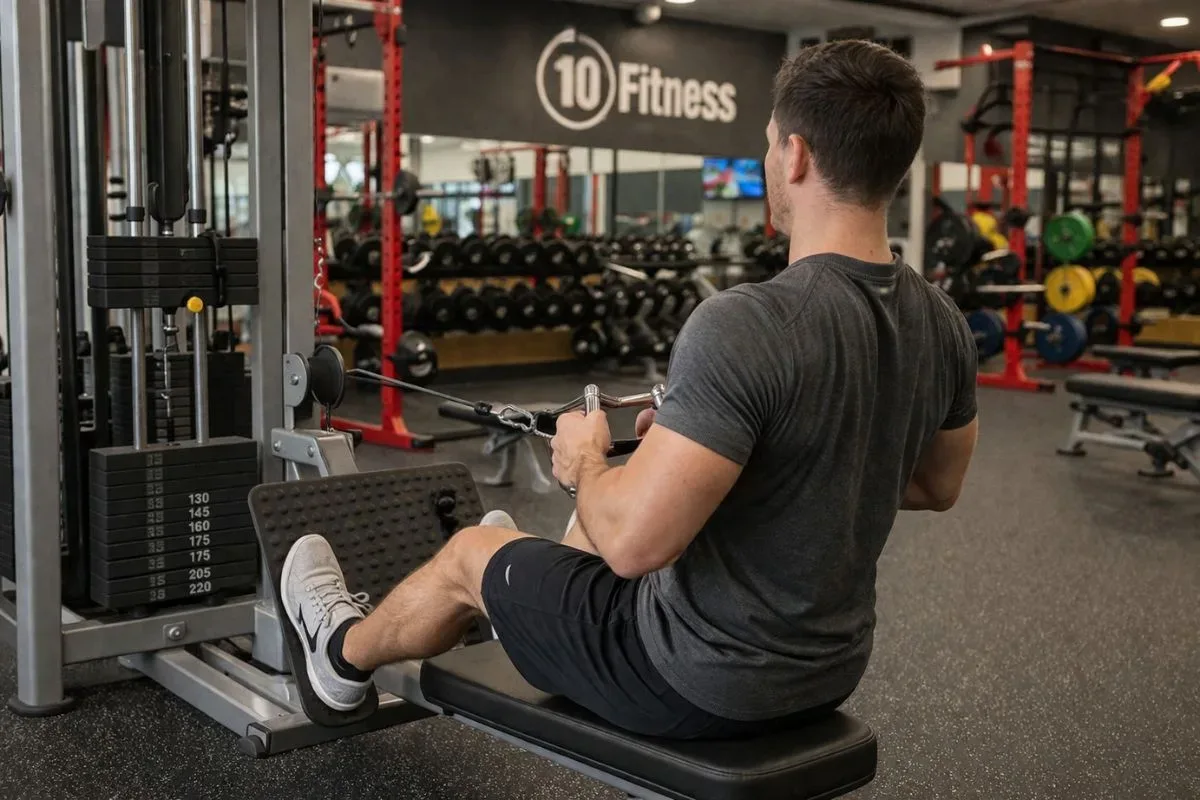
Most people starting out don’t think much about their back. You can’t see it in the mirror, so it doesn’t feel urgent. That’s exactly why it gets skipped. Start with 2 sessions a week, pulldowns, rows, a little lower back work, and you’re already building something most beginners never bother with. Personal training or group training can help if you want someone in your corner from the start. Ready to build your back routine? Find a 10 Fitness gym near you. and start at a pace that feels right.
Key Takeaways
- Your back isn’t just one muscle. The lats, rhomboids, and erector spinae are all in there working together, and building them up makes everything from picking up groceries to sitting at a desk feel a lot better.
- Train twice a week. Anything more than that early on and you’re mostly just making yourself sore, not stronger. Give yourself at least 48 hours between sessions.
- If you’re not sure which exercises to start with, ACE Fitness research points to lat pulldowns, seated rows, and dumbbell rows as the ones that actually light up the most muscle. Start there and you’ll be in good shape.
- Slow down. Seriously. Rounding your lower back or yanking the weight with momentum are the fastest ways to stall progress (or worse, get hurt). Brace your core and control the movement.
- You won’t feel like a different person after week one, and that’s normal. Strength tends to come around weeks 3 to 4. You’ll start seeing real changes in the mirror somewhere around 8 to 12 weeks, if you stay consistent.
- Recovery is part of the work. Sleep, protein, and some stretching between sessions aren’t optional extras, they’re how your muscles actually grow. The 10 Fitness Recovery Room exists for exactly this reason.
- Not sure where to begin? Personal training and Level 10 Team Training at 10 Fitness put a real coach in your corner from your very first rep.
Jump to: Why back training matters | Best beginner back exercises | Workout plan | Common mistakes | Recovery tips | FAQs | Beginner back workouts near you
New gym members almost always end up at the chest machines first. That’s not a criticism. Those muscles face the mirror, and there’s something satisfying about feeling that pump after a good set. The back just doesn’t get that same attention. It’s behind you, you can’t see it working, and so it gets skipped week after week. If you searched for beginner back workouts near me, this plan is simple enough to use at any 10 Fitness location. This guide covers which muscles you’re actually training, how to build a simple routine, the mistakes that trip up almost every beginner, and how 10 Fitness makes all of it easier.
Why Are Beginner Back Workouts Important?
Your back is working right now. Sitting, standing, reaching for your coffee. It doesn’t get a day off. And if you’ve ever thrown it out doing something completely ordinary, like picking up a bag or twisting to look behind you, you already know how much it matters.
Starting a back routine early is genuinely one of the better things you can do for yourself. Not just for the gym. For everything.
Back training can support everyday movement and help you build strength over time. It is not a substitute for medical care, and a new routine should match your experience and current health. If you have back pain, an injury, or a health concern, talk with a qualified healthcare professional before starting or changing your routine.
There are three main muscle groups you’re building when you train your back:
- Lats (latissimus dorsi): The big wide muscles running down both sides. Strong lats help you pull things, sit up straighter, and yes, they look pretty great in a tank top or backless dress too. Worth the effort any way you look at it.
- Rhomboids: These sit between your shoulder blades and pull them back together. They’re the reason you’re not hunched over your phone right now. Well, ideally.
- Erector spinae: They run along either side of your spine and keep you upright all day. (StatPearls has a detailed breakdown if you want to go deeper on the anatomy.)
All three work together. They keep you standing tall, help you move without wincing, and take some of the daily load off your spine.
You don’t need to memorize any of this to get results. You just need to actually show up and do the work consistently.
If you’re brand new to lifting in general, our general strength training guidance is worth reading first. But back exercises for beginners don’t need to be complicated. A handful of solid movements, repeated week after week, is enough to build something real.
Here’s what those movements actually look like.
What Are the Best Beginner Back Exercises?
The best beginner back workouts start with pulldowns, rows, and simple lower back work because these movements are easy to pick up and they actually work, even in your very first week.
Six exercises make up the core of this list: the lat pulldown, seated cable row, dumbbell row, superman hold, face pull, and good morning. Each one comes with form cues you can actually use and a sets/reps target to follow from day one.
Everything here works with equipment you’ll find at 10 Fitness. Cable machines, dumbbells, a barbell, a mat. Some of these names might not mean anything to you yet. That’s fine. We’re going to walk through all of them.
Lat Pulldown
Targets: Lats (the large muscles that run down either side of your spine)
Sit at the cable machine and grab the bar a little wider than your shoulders. Now pull it straight down to your upper chest. As the bar gets close, squeeze your shoulder blades together like you’re trying to crack a walnut between them. Then let it rise back up slowly. Controlled. Don’t just release it and let the stack clank. That slow return is doing more work than people realize.
Sets/Reps: 3 sets of 10 to 12 reps
You pick the weight on this one (seriously, start lighter than you think you need to). Get comfortable with the movement first. Build confidence before you build load. If the cable machine feels unfamiliar, just ask a trainer to set it up once. Takes 30 seconds, and then the whole thing makes a lot more sense.
Seated Cable Row
Targets: Rhomboids and mid-back
Sit down, feet on the footrests, a soft bend in your knees. Grab the handle and row it into your midsection. Here’s the part most beginners skip: really squeeze your shoulder blades together at the end of the pull. Like you’re trying to hold a pencil between them. Then let your arms travel back out slowly, following the cable. Don’t rush it.
Sets/Reps: 3 sets of 10 to 12 reps
Dumbbell Row
Targets: Lats and rhomboids
Plant one hand and one knee on a flat bench, back flat and roughly parallel to the floor. Pick up the dumbbell with your free hand and row it up toward your hip. Think about driving your elbow toward your back pocket, not flaring it out to the side. Lower it under control. Then switch sides and do the same thing.
Sets/Reps: 3 sets of 10 reps per side
Most people have one side that’s noticeably stronger, especially early on. Training each arm separately like this is one of the simplest ways to start evening that out before the gap gets bigger.
Superman Hold
Targets: Erector spinae (lower back muscles)
No equipment here. Lie face down on a mat with your arms stretched out in front of you, like you’re flying. Lift your arms, chest, and legs off the floor at the same time. Hold for 2 to 3 seconds. Lower back down with control. That’s one rep.
Sets/Reps: 3 sets of 10 reps
It looks easy. Around rep six or seven your lower back will disagree, and that’s exactly the point.
Face Pull
Targets: Rear deltoids and rhomboids
Set a cable machine (or loop a resistance band) at roughly face height. Grip the rope attachment with both hands and pull it toward your face, keeping your elbows high and wide the whole way. If you sit at a desk for most of the day, your shoulders are probably carrying more forward tension than you’d expect. This is the movement that starts pulling things back into balance.
Sets/Reps: 3 sets of 12 to 15 reps
Good Morning
Targets: Lower back and hamstrings
Stand with your feet shoulder-width apart and your hands laced behind your head. If you’re adding a barbell, keep it very light and rest it across your upper back. Soft bend in the knees. Back flat throughout. Hinge at your hips and let your torso tip forward until it’s close to parallel with the floor. Then drive your hips forward and stand back up. One rep done.
Sets/Reps: 2 sets of 10 reps
Go lighter than you think you need to (I mean it). This one takes a few sessions to feel natural, and form matters way more than load right now. If it feels awkward or uncomfortable at first, that’s completely okay. Bird dogs and back extensions are friendlier starting points that build the same lower back strength with a lot less to think about. Bodyweight only is a perfectly valid way to start this one too.
ACE Fitness research (published 2018) confirms that rowing movements and pull-down exercises produce the highest muscle activation in the back, which is why these exercises anchor every good beginner back workout. The science backs up what experienced gym-goers already know: you don’t need a complicated program to build real strength.
If you’re just getting started, check out our beginner gym workout guide to see how these back exercises fit into a full-body training routine.
Now that you know which exercises to do, the next step is knowing how to put them together, and how often to train.
How to Build a Beginner Back Workout Routine
Hit your back 2 times per week, with at least 48 hours between sessions. That rest isn’t wasted time. It’s actually when your muscles do the growing.
Monday and Thursday is a simple split that works. You get enough frequency to make progress without hammering muscles that are still figuring out what you’re asking of them.
How Heavy Should I Start?
Lighter than you think. Seriously.
Pick a weight where you can actually control the movement: chest up, core tight, and a slow lowering phase on every rep. Not a weight that feels impressive. A weight that lets you do the exercise correctly for all three sets.
Here’s the honest truth: most beginners grab something too heavy because light weights feel like cheating. They’re not. If your back is rounding, if you’re using momentum, if the last two reps are a fight for survival, the weight is too heavy. Drop it. Nobody’s watching, and even if they are, nobody’s impressed by sloppy form.
Start light, build the movement pattern, add weight once you’ve got it locked in. That’s the whole plan.
Your Beginner Back Workout Plan
Here’s a straightforward beginner back workout routine you can follow on each training day:
This should take about 25 to 30 minutes, including your warm-up and cool-down.
| Exercise | Sets | Reps |
|---|---|---|
| Warm-up: light cardio + arm circles | N/A | 5 minutes |
| Lat Pulldown | 3 | 10 to 12 |
| Seated Cable Row | 3 | 10 to 12 |
| Dumbbell Row (each side) | 3 | 10 |
| Superman Hold | 3 | 10 |
| Face Pull | 3 | 12 to 15 |
| Cool-down: cat-cow, child’s pose | N/A | 5 minutes |
This routine covers every major area of your back: upper, mid, and lower. The volume is manageable. You won’t walk out destroyed. Pair it with a solid beginner workout plan and you’ve got a real foundation to build from.
How to Keep Making Progress
Most people wait until a weight feels easy before they go heavier. Don’t do that. Once you’re moving through your sets with clean form, add 2.5 to 5 lbs. That’s it. You don’t need to feel ready. You just need to do a little more than last time.
That’s progressive overload, and it’s the actual reason a beginner workout plan works. The principle isn’t complicated. The hard part is trusting it when the jumps feel small and the progress feels slow. Keep adding. The consistency builds something, even when you can’t see it yet.
3 Common Mistakes Beginners Make
- Rounding your lower back during rows. Brace your core and keep your spine neutral through the whole rep. Healthline notes that a neutral spine is foundational to both injury prevention and posture improvement.
- Using momentum instead of muscle. If you’re swinging the weight up, it’s too heavy. Drop down, slow the lowering phase to 2 to 3 seconds, and actually feel the muscle do the work. Momentum is just ego with bad form.
- Skipping the warm-up. Five minutes of light movement before you load your back gets blood into the joints and loosens up the tissue. People skip it until the day they can’t.
Recovery is part of the training, not a break from it. What happens after you leave the gym matters more than most beginners expect. A structured gym routine for beginners at 10 Fitness builds that recovery time in from day one, so you’re not left guessing at how much is too much.
Recovery Tips and How 10 Fitness Can Help
Here’s what nobody tells you when you start training: the workout itself is just the trigger. Your back muscles rebuild while you sleep, while you eat lunch, while you’re doing absolutely nothing gym-related. All the growth happens after you leave. So what you do between sessions matters just as much as what you do during them.
Sleep. Water. Protein. You’ve heard it before. It’s not exciting advice. But the people who keep making progress month after month are usually the ones who actually follow through on the basics instead of skipping them when life gets busy.
Stretch It Out After Back Day
Most people head straight for the door when they finish their last set. Completely understandable. But five minutes on the mat can be the difference between waking up ready to move and waking up shuffling around like you aged 40 years overnight.
- Child’s pose: Sit your hips back toward your heels, arms stretched forward. After heavy pulling, the way this opens up your lats and decompresses the lower back is genuinely satisfying.
- Cat-cow: On all fours, slowly arch and round your spine. Your whole back gets involved. It just feels good.
- Thread the needle: From all fours, slide one arm under your body and rotate your torso down toward the floor. That tight spot between your shoulder blades that nobody can ever quite reach? This one finds it.
Hold each stretch 20 to 30 seconds. Breathe through it. No forcing.
Support Your Recovery at 10 Fitness
Where available, 10 Fitness locations have a Recovery Room with cryotherapy, compression boots, zero gravity chairs, massage chairs, and red light therapy. These tools exist because soreness is real, and showing up to your next session still wrecked from the last one isn’t helping anybody. If you train in North Little Rock, the Recovery Room is worth building into your regular routine. It takes enough edge off that your second back day doesn’t feel like punishment. If you’re curious about one of those specific tools, we put together a solid overview of red light therapy for muscle recovery.

You Don’t Have to Figure This Out Alone
Walking into a weight room for the first time is a lot. Everyone seems to already know what they’re doing, and figuring out where to start, how much weight to use, or whether your form is actually correct can feel genuinely overwhelming.
Personal training at 10 Fitness helps with that. Your trainer builds a program around your goals and where you actually are right now, not where they assume you should be. Getting form right early on saves you from a lot of frustration later, and having someone in your corner for those first sessions makes the whole experience feel different.
If you prefer working out alongside other people, Level 10 Team Training is worth a look. Instructor-led sessions, a crowd that’s genuinely welcoming, and enough energy in the room to keep you moving without making you feel like you’re behind. People come back because they actually like being there.
10 Fitness has been locally owned and operated since 2007, built around one belief: Fitness for Every Body. Wherever you’re starting from, there’s a place for you here.
Find a gym near you and take that first step. If North Little Rock isn’t your closest club, 10 Fitness also serves members from Maumelle, Downtown Little Rock, University, Cantrell, Conway, Cabot, Bryant, and more.
Beginner Back Workouts Near You in North Little Rock
If you are in North Little Rock, Sherwood, or Lakewood and want a comfortable place to start, 10 Fitness North Little Rock is a strong fit for beginner back workouts. The club has expanded free weight and functional training areas, plus a Recovery Room that supports soreness and recovery between sessions. That makes it a great match for a back training plan built around rows, pulldowns, and posture work.
Frequently Asked Questions
How many days a week should beginners work out their back?
Start with two. Muscles grow during recovery, not during the workout itself, so hammering your back three or four times a week when you’re just getting started usually works against you. Two solid sessions, real rest in between, and you’ll be surprised how fast things progress. You can always add more later.
What back exercises are safe for complete beginners?
Lat pulldowns, seated cable rows, dumbbell rows, and superman holds are all solid starting points. They teach your back how to move without demanding the kind of technique that takes months to develop. Deadlifts are great, just not on week one. They’ll still be there when you’re ready for them.
Can I do beginner back workouts at home without equipment?
Superman holds, bird dogs, and resistance band rows are genuinely effective, and not just because you have no other option. A lot of people build real foundational strength at home before they ever set foot in a gym. Equipment helps, but it’s not the whole story.
How long does it take to see results from back training?
Strength shows up faster than most people expect, usually around weeks three or four. The visual changes, the way your back actually fills out, take closer to eight to twelve weeks. Sleep, protein, and progressive overload all matter more than people want to admit. But here’s what most people get wrong: they quit at week five, right before things start clicking.
Should I train back and biceps on the same day?
This pairing has been around forever for good reason. Your biceps are already doing work on every back exercise, so combining them on the same day just makes sense. One rule: do your back first. Pre-fatigued arms mean weaker pulls, and your whole session pays the price.
Where can I do beginner back workouts near me?
Every 10 Fitness location is set up for this kind of training, but if you’re in North Little Rock, the JFK club specifically has expanded free weights, functional training space, and a Recovery Room that’s worth checking out. Find a location near you.
Should beginners use machines or free weights for back workouts?
Machines first, and that’s not the boring answer it sounds like. When you’re new, free weights split your focus between controlling the weight and actually feeling the muscle work. Machines take the balance question off the table so you can focus on the pull itself. Once that mind-muscle connection starts clicking, dumbbell rows and other free weight movements feel a lot less chaotic. The free weights aren’t going anywhere. Get comfortable, then graduate.
Consistent back training can help you build strength for everyday movement and feel more confident in your routine. Choose a schedule you can repeat, use controlled form, and ask a trainer for help when you need it.
10 Fitness North Little Rock is here to support that journey, whether you are on your first pulldown or your fiftieth. Memberships come in different options to fit your schedule and your goals, so there is something for wherever you are starting.
Ready to get started? Join 10 Fitness today and your first back day could be this week.