Red light therapy is one of the most practical recovery upgrades for people who train hard and want to feel better between sessions. You put in the work at the gym: heavy sets, interval training, tough classes, long weeks. But what you do after your workout is often the difference between “I’ll be back tomorrow” and “I need three days off.”
If you’re searching for gyms with red light therapy in Arkansas, this guide explains what red light therapy is, why it’s useful for gym-goers, how to use it effectively, and also how to build it into a recovery routine that actually supports progress, without replacing the basics (sleep, protein, hydration, and smart programming).
Key Takeaways
- Red light therapy after workout sessions supports recovery by helping your cells produce more energy (ATP), which can speed tissue repair and reduce soreness.
- The most discussed performance/recovery wavelengths are ~660nm (red) for more superficial tissue and ~810–850nm (near-infrared) for deeper tissue.
- Best timing for recovery: within 30–60 minutes post-workout (when possible).
- A realistic routine for gym-goers: 2–4 sessions per week, especially on your hardest training days.
- For those searching for gyms with red light therapy in Arkansas, 10 Fitness Recovery Rooms include red light therapy and other recovery tools.
What Is Red Light Therapy?
Red light therapy (often paired with near-infrared light) is a recovery method that uses specific wavelengths of light to support cellular function. It’s popular in fitness recovery because it’s:
- non-UV (not a tanning or “sun” light)
- passive (you don’t have to “do” anything during it)
- fast (you can fit it in after training)
- easy to pair with other recovery habits (stretching, hydration, protein)
Red and near-infrared light can stimulate your mitochondria (your cells’ energy centers), supporting ATP production. ATP is the energy your cells rely on for repair processes, so when training causes fatigue and micro-damage, red light therapy is designed to support the recovery side of the equation.
Why Gym-goers in Arkansas are Adding Red Light Therapy to Their Routine
Most people don’t struggle because they don’t know how to work out. They struggle because they can’t recover consistently enough to train consistently.
Red light therapy can help close that gap by supporting:
1) Reduced Post-workout Soreness (DOMS)
Delayed onset muscle soreness (DOMS) often shows up 24–72 hours after training, exactly when you’re supposed to hit your next session. If soreness is the thing that makes you skip leg day or delay your next workout, red light therapy is also worth considering as a routine, not a one-off.
2) Better Training Frequency (the “Hidden” Benefit)
Even if you don’t feel a dramatic change after one use, consistent recovery work can make you feel “ready enough” more often. That usually leads to:
- fewer missed sessions
- better long-term strength and physique results
- improved momentum and motivation
3) Improved Circulation Support
Additionally, a commonly cited mechanism is improved circulation related to nitric oxide pathways (vasodilation). Better circulation can help deliver oxygen and nutrients and support the clearing of metabolic byproducts, especially helpful when you’re stacking hard sessions each week.
4) Recovery That Doesn’t Interfere with Training Adaptations
Some recovery methods (especially when overused) can potentially blunt adaptation if you rely on them aggressively right after every single session. Red light therapy is typically positioned as a supportive recovery option that gym-goers can use regularly, especially when soreness, stiffness, or cumulative fatigue is limiting performance.
After Workout Recovery
After strength training, conditioning, or high-volume workouts, you’re dealing with:
- depleted energy stores
- microscopic tissue stress
- inflammation signaling
- reduced range of motion and soreness
Red light therapy is used after training because it’s meant to support cellular energy processes and the body’s recovery response, helping you feel ready for your next workout sooner.
Best time to use red light therapy: Pre-workout vs. post-workout
Post-workout (Most Common for Recovery)
Best for: soreness reduction, recovery support, staying consistent
Timing: ideally within 30–60 minutes after your session
If your goal is “I want to train again tomorrow and not feel wrecked,” post-workout use is the practical choice.
Pre-workout (Optional Performance Support)
Best for: people experimenting with warm-up support and readiness
Timing: short session before training
Some athletes use red light therapy before lifting as part of a readiness routine. If you do this, keep it consistent and track your results (performance, soreness, and sleep) for a few weeks so you’re not guessing.
Length Per Session
Firstly, most gym members do best with a plan that’s:
- short enough to stick with
- consistent enough to matter
A practical starting range is 10–20 minutes on the area you trained most (legs, back, shoulders, etc.), 2–4 times per week.
If you’re new to it, start on the lower end for the first 1–2 weeks, then increase if you’re tolerating it well and you’re actually using it consistently.
Muscle Groups & Recovery Impact
Intensive gym-goers most commonly use red light therapy on:
- quads and hamstrings after leg day
- lower back/glutes after deadlifts or long sitting days
- shoulders and chest after pressing workouts
- upper back after pulling days
A simple rule: prioritize the areas that get the most sore and the sessions you can’t afford to miss.
What to Look for in Gyms with Red Light Therapy
If you’re comparing gyms with red light therapy, don’t just ask “Do you have it?” Also ask whether it’s set up for real-world consistency:
- Is it in a dedicated recovery area so you’ll actually use it?
- Can you use it after workouts without waiting?
- Is it paired with other recovery tools (compression, massage, stretching space)?
- Is the gym convenient enough that you won’t stop going after two weeks?
Convenience and consistency beat “perfect specs” for most people.

Gyms with Red Light Therapy in Arkansas
If you’re searching for gyms with red light therapy in Arkansas, 10 Fitness is the place to start because it combines serious training with dedicated recovery spaces.
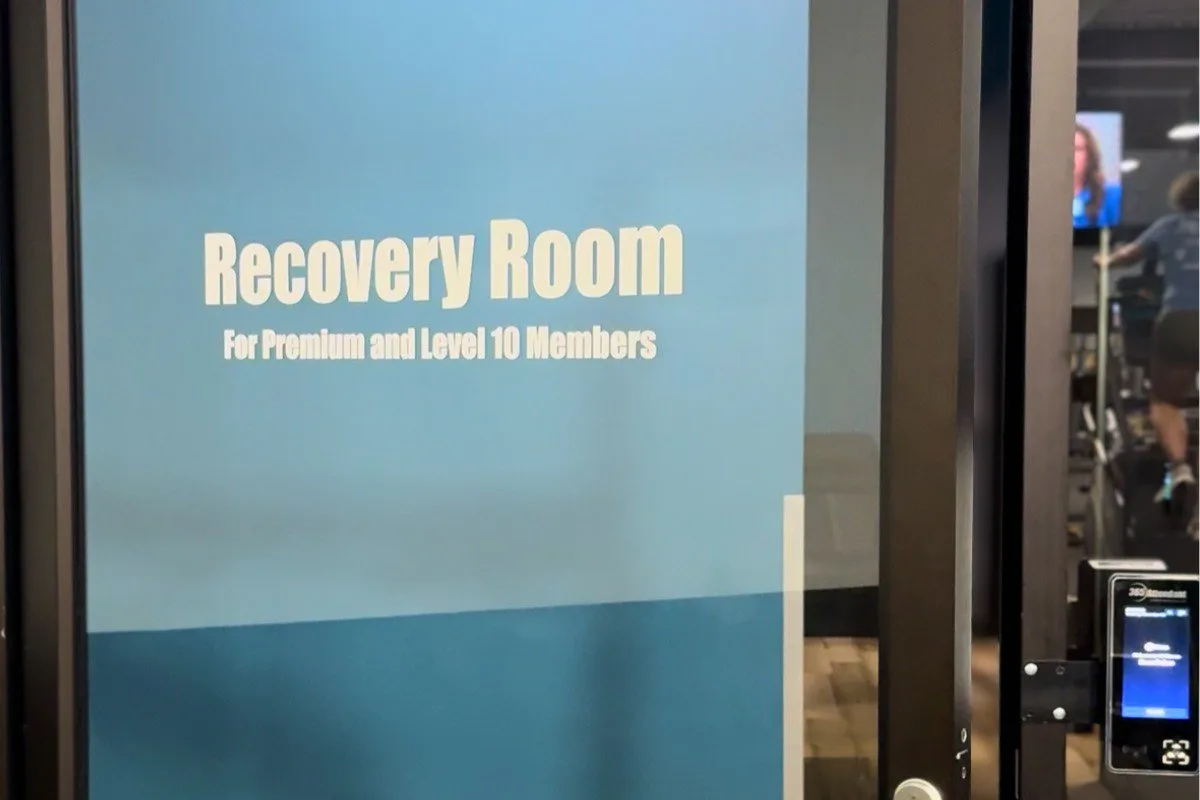
10 Fitness Recovery Rooms
10 Fitness has also built Recovery Rooms in North Little Rock, Maumelle, and Paragould, featuring multiple recovery tools.
Typical recovery rooms include:
- Red light therapy
- Cryotherapy (CryoLounge Plus)
- Compression boots
- Zero gravity chairs
- Massage chairs
- Power Plate
- Stretching equipment
Tip for local searchers: amenities can vary by club, so confirm red light therapy availability at your preferred 10 Fitness location.
Recommended Post-workout Red Light Therapy Routine (Simple and Repeatable)
To start, here’s a gym-friendly protocol you can actually stick to:
- First, finish your workout (strength, cardio, group training, or personal training).
- Hydrate and do a quick 2–5 minute cooldown (easy walk + breathing).
- Use red light therapy post-workout on the area you trained most.
- Keep it consistent: aim for 2–4 times per week for 4–6 weeks before judging results.
If your legs are always the limiter, use red light after leg day. If shoulders and upper back are constantly tight, prioritize that.
Red Light Therapy Against Other Recovery Methods
Red Light Therapy vs. Ice Baths
Ice baths can feel great for immediate soreness and can also reduce the perception of pain in the short term. Red light therapy is typically used as a recovery support tool that doesn’t rely on intense cold and is easier for many people to do consistently after training.
Red Light Therapy vs. Stretching
Stretching improves mobility and range of motion, especially if you sit a lot, lift heavy, or do repetitive cardio. But stretching doesn’t target cellular energy processes in the same way. The best approach for most gym-goers is:
- Stretch for movement quality
- Use red light therapy for recovery support
- Combine both when you’re training hard
Red Light Therapy vs. “Just Resting”
Rest matters, but passive rest alone doesn’t always keep up with high training volume. Red light therapy is popular because it gives you a structured “recovery habit” you can do in the same place you train.
Safety (& Who Should Be Cautious)
Red light therapy is generally well-tolerated, but you should do your research and also check with a healthcare professional before using it if you:
- Are pregnant
- Have a medical condition affected by light exposure
- Take medications that increase light sensitivity
- Have an eye condition (follow device guidance and additionally, avoid staring at the light)
Also, keep skin clean and skip heavy lotions/oils right before a session if your goal is deeper light penetration.
FAQ: Arkansas Gyms with Red Light Therapy
Benefits of Red Light Therapy Post-workout
It’s commonly used to support recovery by helping cellular energy production (ATP), supporting circulation, and reducing soreness so you can train more consistently.
Beginning Recovery Use
A practical starting point is 2–4 sessions per week, especially after your hardest training days.
Feeling Results
Many people evaluate results over 4–6 weeks of consistent use, because recovery tools tend to work best as routines, not one-time fixes.
Recover with Red Light Therapy at 10 Fitness
Red light therapy is most valuable when it helps you do the one thing that drives results: train consistently. If you’re in Arkansas and searching for gyms with red light therapy, choose a gym where recovery is easy to use right after your workout.
That’s why 10 Fitness stands out: its Recovery Rooms make red light therapy a convenient part of your weekly training rhythm, not an extra errand.