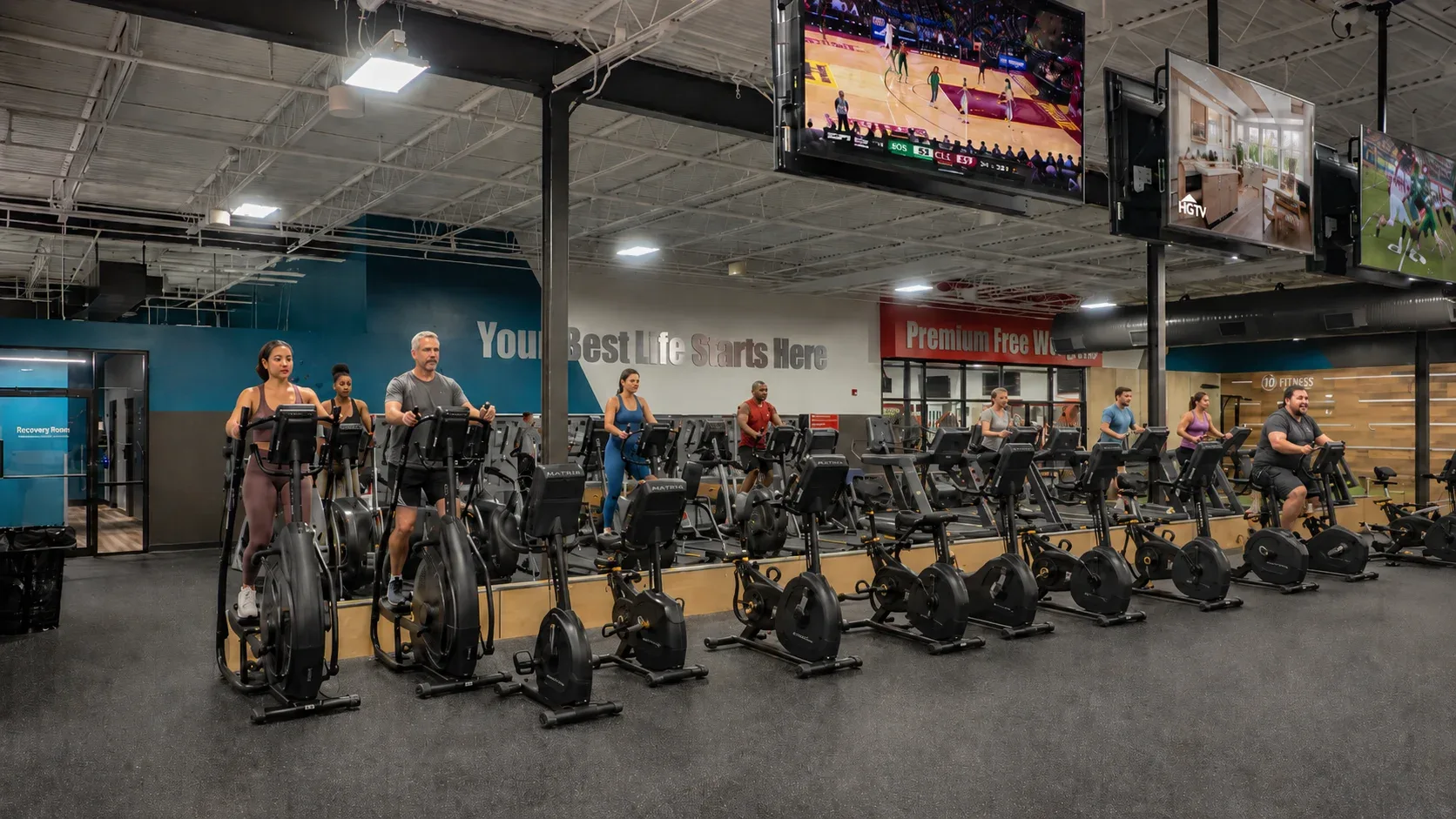
Three times a week. Twenty minutes. A pace where you can still chat with the person on the treadmill next to you. That’s genuinely all it takes to start building cardio endurance, and if that sounds too simple, good. Beginner cardio gets overcomplicated constantly, and most of what people think they need before starting (a fitness base, the perfect shoes, some kind of plan) isn’t actually required. You just need to show up. Here in Arkansas, where June through September turns outdoor exercise into a humidity battle you didn’t sign up for, that showing-up happens a lot easier inside a climate-controlled gym with equipment that works.
Jump to what you need:
What Is Cardio and Why Does It Matter?
Your heart is a muscle. Cardio is how you work it. Any movement that gets your heart rate up and keeps it there counts: a walk, a bike ride, a slow jog around the block. The word itself comes from “cardiovascular,” which just means your heart and lungs are in on the effort too, right there with your legs and arms.
Your energy is usually the first thing that shifts. Not dramatically, not overnight, but after a few weeks of consistent cardio you’ll notice you’re not hitting the 2pm wall as hard. Sleep tends to follow: deeper, easier to fall into. And on the stress front, there’s something about getting your body moving that quiets the mental noise in a way that’s hard to replicate sitting still.
The changes don’t announce themselves. They sneak up on you. One day you’re halfway up the stairs before you even register you’re climbing them. Or you reach the end of a brutal day and realize there’s still some gas in the tank, which wasn’t true a month and a half ago. It accumulates that way, quietly, until one day it doesn’t feel quiet anymore.
Walking on a treadmill is cardio. You don’t need to run. You don’t need to sweat through a high-intensity class to get real benefits. Any movement that raises your heart rate and keeps it there is doing the work.
Want to pair cardio with strength training? Our beginner workout plans article walks you through how to structure both.
The Best Beginner Cardio Options at the Gym
Picking the first machine is genuinely the hardest part of a first workout. Everything else gets easier once you just choose something and start moving.
The treadmill gets picked first by a lot of beginners, and for good reason: your legs already know how to walk. Hop on, set a comfortable pace, and ignore anyone moving faster than you. Running is never required. Plenty of members have built a strong cardio habit without breaking into a jog even once, and that counts. If your location has Cardio Cinema, the treadmill becomes a genuinely easy place to lose 30 minutes: pick a movie, tune everything else out, and just keep moving. Not all locations have Cardio Cinema, so check 10fitness.com/amenities/cardio-cinema/ to see if yours does and to stay current on the movie schedule.
If joint pain has been a reason you’ve avoided cardio in the past, the elliptical is worth trying before anything else. The motion is continuous and smooth, which takes real pressure off your knees and hips compared to running on pavement.
The stationary bike lets you set your own pace from the moment you sit down. Crank the resistance up or leave it light; either works depending on what your legs are telling you that day. If the upright seat feels a little awkward at first, look for the recumbent version. The reclining seat adds back support and tends to feel a lot more approachable when you’re just getting started.
The rowing machine looks harder than it is. The trick is driving with your legs first, not pulling with your arms. Once that clicks, the rhythm feels natural, and the full-body demand is genuinely satisfying.
Save the stair climber for a few weeks in. It runs harder than anything else on this list, and your cardio base will catch up faster than you think. Consider it something to look forward to.
How Long and How Often Should You Do Cardio?
Three days a week. That’s it. Not five, not every day, not a schedule that requires a spreadsheet.
Twenty to thirty minutes per session, three times a week, gives you enough structure to build a real habit without grinding yourself into the ground. The American Heart Association recommends 150 minutes of moderate-intensity activity per week for adults, and that’s a solid target to work toward over time. Three 20-minute sessions gets you to 60 minutes. That’s not a consolation prize. That’s a genuinely strong start.
Rest is where the work pays off. You don’t get stronger during the workout. You get stronger after it, while you’re sleeping or sitting on the couch. Give your body that time and it’ll show up for you next session.
Monday, Wednesday, Friday is one way to space things out so you’re not training on back-to-back days. The actual days are up to you. What matters is finding a pattern you’ll stick to, not one that looks neat on paper.
The first few weeks aren’t about intensity or optimization. They’re about showing up enough times that cardio stops feeling like a decision and starts feeling like Tuesday.
How Hard Should You Push Yourself?
You’re breathing a little harder, maybe flushed, but you could still answer a question without gasping for air. That’s moderate intensity, and that’s exactly where you want to live for most of your workouts.
The talk test is the simplest way to check yourself without a heart rate monitor or any gear. Mid-workout, try saying a sentence out loud. If it comes out easily, you’re at moderate intensity. If you’re gasping between words and seriously considering lying down, you’ve gone too hard.
Vigorous effort has its place too, eventually. But if you’re just getting started, moderate intensity is almost always where you’ll make the most progress, and where you’ll actually want to show up again tomorrow.
One mistake that trips a lot of new exercisers up: going all-out in the first few sessions and then being too wrecked to come back for days. Intense effort that wipes you out is far less useful than moderate effort you can actually repeat, week after week. Consistency builds fitness. Heroics in week one usually just build soreness.
Hit the ten-minute mark and feel completely winded? Your body is just meeting something it hasn’t done in a while. Give it a week. It adjusts quicker than you’d think.
A Simple 4-Week Beginner Cardio Plan
Weeks 1 and 2: Three days a week, 20 minutes per session. Spread them out so you’re not hitting two days in a row. Pick whatever machine you feel like that day, keep the pace easy enough to talk without gasping, and don’t overthink the rest. Show up. That’s the whole job right now.
Weeks 3 and 4: Stretch sessions to 25 or 30 minutes and aim for three to four days per week. Try a different machine each session to keep things fresh. You’ll probably notice that what felt genuinely hard in week one feels almost routine now. That’s adaptation doing exactly what it’s supposed to do.
After 4 weeks: Add five minutes to your sessions, or nudge the resistance or incline up one small notch. Month two isn’t about running a marathon. It’s about feeling noticeably better than you did on day one.
At some point, most people find cardio alone gets them so far and then plateaus. Adding some lifting changes that. Our beginner workout plans article lays out exactly how to structure both in the same week without making your schedule harder than it has to be.
Cardio Cinema and Arkansas Summers
Arkansas summers don’t leave many outdoor cardio options on the table. From June through September, the humidity does something to you before you’ve even broken a sweat. A ten-minute walk outside can feel like a session before you’ve hit your stride, and for a lot of people, that’s enough to make cardio feel impossible to stick to consistently.
Cardio Cinema at select 10 Fitness locations changes that calculation. It’s a dedicated theater-style room where you run your session on a treadmill, bike, or elliptical while a movie or show plays on a large screen. Not every location has one, so check the Cardio Cinema page to confirm availability at your club and see what’s currently playing; the schedule rotates. The practical effect: thirty minutes goes by faster, and you’re more likely to come back tomorrow. If you’ve ever abandoned a cardio session because staring at the gym wall felt like punishment, this is the answer to that problem.
10 Fitness Cantrell in west Little Rock has 24/7 access and the full equipment lineup from this plan. A Bowman Road location is coming in 2026. Find a 10 Fitness near you to see what’s available at your closest club.

Not Sure You’re Working at the Right Intensity?
That question alone is worth a conversation. Our nationally certified personal trainers work with members at every 10 Fitness location: beginners, people coming back after a long break, and everyone in between. If you want a cardio plan that actually fits where you are right now, 10 Fitness personal training is one of the easiest ways to get there. No guesswork, no one-size-fits-all programming. Just a plan built around you.
Questions About Beginner Cardio Workouts
How Long Before I See Results From Cardio?
The first changes from cardio usually catch you off guard: you sleep through the night, you stop hitting a wall at 3pm, and you’re just in a better headspace. That shift happens in the first two to three weeks, well before you’ll notice anything different when you look in the mirror.
Can I Do Cardio Every Day as a Beginner?
Daily walks or gentle movement? Go for it. When you’re ready for structured cardio workouts, aim for three days a week and protect those rest days, because that recovery time is where your body actually gets stronger. Once three sessions start feeling manageable, you can build from there.
Should I Do Cardio or Strength Training First?
We get this one a lot from new members trying to map out their first full routine. If you’re lifting and doing cardio in the same session, do the strength work first. You’ll have better energy and coordination for the weights before the treadmill takes the edge off. That said, the order matters far less than showing up consistently. If you want a weekly plan that maps out how to structure both, the beginner workout plans article lays it out clearly.
Ready to Start Your First Cardio Workout?
Your first session doesn’t need to be impressive. Pick a machine, set a comfortable pace, and see how thirty minutes feels. Find your nearest 10 Fitness and come in whenever it works for you.