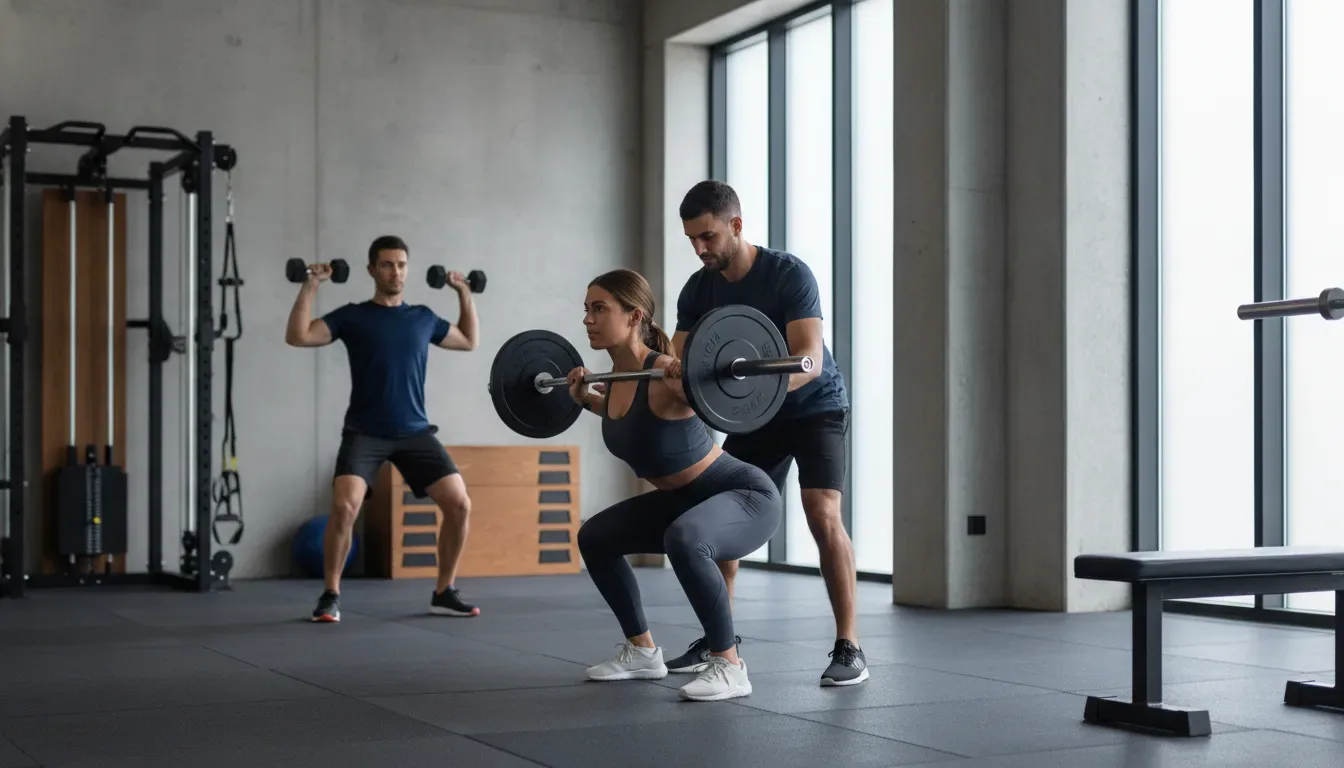
Your body does not need to look a certain way before you start strength training. You can begin with the body you have, at the fitness level you have today, and adjust each exercise to fit your needs. A short workout still counts. Light weights still count. Learning how to move with control still counts. Over time, consistent training can help you build muscle, support your joints, improve balance, and feel more capable during daily activities. Whether you prefer home workouts, gym machines, free weights, or group classes, this guide will help you understand where to begin and how to make steady progress without comparing yourself to anyone else.
Principales conclusiones
- Begin at your current level: Use bodyweight movements, bands, machines, or light weights to practice controlled form before adding resistance.
- Train consistently and recover well: Aim for two or three weekly sessions, include major movement patterns, and allow rest between workouts.
- Track progress in practical ways: Notice improvements in strength, balance, endurance, daily movement, confidence, and workout consistency, not only changes in body weight.
What Is Strength Training and How Does It Work?
Strength training is exercise that makes your muscles work against resistance. That resistance may come from dumbbells, barbells, gym machines, resistance bands, kettlebells, or your own body weight. As you practice consistently, your muscles and nervous system adapt, helping you move with more control and produce more force.
You do not need to lift the heaviest weight in the gym to get stronger. A beginner workout might include squats, push-ups, rows, lunges, and planks. The goal is to learn each movement, use controlled form, and gradually increase the challenge. The Cleveland Clinic explains that strength training can support muscle strength, bone health, balance, and daily physical function.
Strength training also prepares you for everyday activities. Carrying groceries, climbing stairs, lifting a suitcase, and standing up from a chair all require strength. You can train at a 10 Fitness gym, at home, or anywhere you have enough space to move safely.
Compare Strength and Resistance Training
You may hear the terms strength training and resistance training used interchangeably. Both describe exercise that challenges your muscles against an external force. Strength training often focuses on improving how much force you can produce, while resistance training is a broader term that can include strength, muscle growth, and muscular endurance.
For example, lifting a challenging dumbbell for a few repetitions may focus on strength. Completing several bodyweight squats or a longer resistance-band workout may place more emphasis on muscular endurance. Both approaches can support a well-rounded beginner program.
Resistance can come from your body weight, free weights, bands, cables, or machines. Healthdirect’s guide to strength training explains how beginners can use different types of resistance while learning which exercises feel comfortable and effective. Start with the option that lets you practice good form and stay consistent.
See How Muscles, Bones, and the Nervous System Adapt
Your body adapts to strength training in several ways. When you first begin, some early strength gains come from your nervous system learning to coordinate movement more efficiently. Your brain and muscles become better at working together, which can make an exercise feel smoother before you notice changes in muscle size.
With regular training, your muscles also adapt to repeated resistance. Muscle fibers become better prepared to handle the work, and consistent training can contribute to greater muscle size over time. Your tendons and ligaments support movement too, so increasing your training gradually gives these tissues time to adjust.
Strength training can support bone density as well. Weight-bearing exercise gives your bones a reason to stay strong, especially when paired with adequate nutrition and recovery. Results vary based on your training plan, sleep, food, genetics, and consistency. You do not need to rush the process. Safe, repeated practice matters more than one difficult workout.
Build Strength, Muscle, and Endurance
Strength, muscle growth, and muscular endurance are related, but they are not exactly the same. Strength refers to how much force you can produce. Muscle growth refers to an increase in muscle size. Muscular endurance is your ability to keep working without tiring quickly.
A beginner program can support all three. You might perform squats with a moderate weight to build lower-body strength, use rows to develop your back and arms, and complete bodyweight lunges to challenge endurance. Adjusting the resistance, repetitions, rest periods, and exercise difficulty changes the way your body responds.
Regular training also helps you maintain muscle and strength over time. Without muscle-building activity, strength and muscle mass can gradually decline, particularly as you get older. The National Institute on Aging recommends strength exercises as part of an active lifestyle that supports movement and independence. Your routine does not need to be complicated. A few consistent sessions each week can make a meaningful difference.
Apply Progressive Overload Without Chasing Heavy Weights
Progressive overload means gradually increasing the challenge placed on your muscles. That challenge does not always require heavier weights. You can complete an extra repetition, perform another set, use a slower tempo, improve your range of motion, reduce your rest period slightly, or choose a more difficult exercise variation.
Start with a resistance level you can control from beginning to end. If your form breaks down, the exercise is too difficult for that set. Once the movement feels steady, make one small adjustment and give your body time to adapt before increasing the challenge again.
For example, you might begin with two sets of eight bodyweight squats. After a few sessions, you could complete three sets, add a few repetitions, or hold a light dumbbell. Healthline’s strength training guidance emphasizes controlled form, which is especially important when you are learning a new exercise. Progress should feel manageable, not rushed.
Correct Common Beginner Misconceptions
You do not have to belong to a gym to strength train. Bodyweight exercises, bands, and household items can provide useful resistance. A gym gives you more equipment and exercise options, including machines that may help you learn certain movements with added stability.
You also do not need to feel sore after every workout for it to count. Soreness can happen when your body encounters a new challenge, but it is not the only sign of progress. Better balance, improved form, more controlled repetitions, and greater confidence are meaningful results too.
Finally, lifting heavy weights is not the same as training effectively. Choose a resistance that lets you complete each repetition with control. Learn the exercise first, then increase the challenge when your technique feels consistent. If you are unsure where to begin, ask a 10 Fitness trainer to show you beginner-friendly options and help you create a plan that fits your goals.
What Are the Benefits of Strength Training?
Strength training does more than help you lift heavier weights. It supports the muscles, bones, and connective tissues that help you move through daily life, from carrying groceries to climbing stairs. Regular resistance exercise can also improve balance, energy, sleep, confidence, and your ability to handle physical tasks.
You do not need to train like a competitive athlete to see progress. Bodyweight exercises, resistance bands, machines, dumbbells, and barbells can all help you build strength. The best approach is the one you can perform consistently, with good form and enough recovery between sessions.
Strength training can also fit different goals. You may want to build muscle, support your joints, improve your athletic performance, manage your weight, or simply feel more capable in your body. Start with a manageable routine, then gradually make your workouts more challenging as your strength and confidence grow.
Strengthen Muscles, Bones, and Connective Tissue
Resistance exercises place a healthy challenge on your muscles, tendons, ligaments, and bones. Over time, your body adapts by making these tissues stronger and more capable. Stronger muscles can make everyday movements easier, while stronger connective tissue helps support your joints during exercise and daily activities.
Weight-bearing exercise also supports bone health. Squats, lunges, step-ups, presses, and similar movements encourage your body to maintain bone strength while building the muscles around your joints. The National Osteoporosis Foundation explains how exercise supports bone health, including the role of strength and weight-bearing activities.
You can start with simple movements, such as sit-to-stands from a bench, wall push-ups, or light dumbbell exercises. Perform each repetition with control, and increase the challenge only when your technique feels steady.
Improve Balance, Mobility, and Daily Movement
Strength gives your body more support during movement. Stronger legs can help you stand from a chair, walk up a hill, or stay steady on uneven ground. A stronger core can help you brace while lifting, while stronger back and shoulder muscles support reaching, carrying, and pulling.
Strength training may also improve mobility when you perform exercises through a comfortable range of motion. Moving your joints regularly can help you feel less stiff and more confident. Healthdirect’s guide to strength training for beginners covers how resistance exercise can support muscle function, joint health, and daily activity.
You do not need to force a deep stretch or perform complicated exercises. Focus on smooth repetitions and use a range of motion that feels challenging but manageable. A trainer can suggest modifications if you are new to exercise or need to work around an injury or physical limitation.
Manage Body Composition and Weight
Strength training can help you build and maintain lean muscle mass. Muscle tissue uses energy to function and maintain itself, so developing more muscle can support your overall daily energy needs. Resistance exercise works best alongside nourishing meals, regular movement, and enough recovery.
It may also help you maintain muscle while losing body fat. This matters because the number on a scale does not show the full picture of your health or progress. Changes in strength, measurements, how your clothes fit, and how you feel during workouts can provide useful information too. The Cleveland Clinic explains how strength training supports muscle development and weight management.
Keep your focus on sustainable habits rather than trying to change everything at once. Two or three weekly workouts, regular walks, balanced meals, and consistent sleep can create a strong foundation. You do not need to follow a perfect plan to make meaningful progress.
Improve Mood, Confidence, Energy, and Sleep
Exercise gives you time to focus on your body and step away from daily stress. Strength training can help you release tension, stay present during each repetition, and notice what you can do. Finishing a workout may also create a sense of accomplishment, especially when you complete a movement that once felt difficult.
As your strength develops, everyday activities may require less effort. Carrying bags, taking the stairs, or joining a fitness class can feel more comfortable. Regular physical activity may also support better sleep and mental well-being. Healthdirect notes that strength training can contribute to positive feelings and mental health.
Keep your workouts realistic so they support your energy instead of leaving you exhausted. A 20-minute session still counts. Choose exercises you enjoy, listen to music that keeps you focused, and record small wins such as completing an extra repetition or using smoother form.
Support Long-Term Health and Resilient Movement
Strength training helps you maintain the physical capacity to move, work, play, and care for yourself over time. Building stronger muscles can support your joints, while practicing balance and controlled movement may help you respond with more confidence to everyday challenges. It also gives you a practical way to stay active as your goals and schedule change.
Research connects regular strength training with a lower risk of several long-term health conditions, including cardiovascular disease and diabetes. These findings do not mean that one workout guarantees a specific result. They show why resistance exercise belongs in a well-rounded fitness routine. The World Health Organization recommends regular muscle-strengthening activity for adults.
Think of strength training as preparation for the life you want to live. You can adjust the exercises, resistance, and workout length as your needs change while keeping the habit going. Consistent, manageable training can help you build a body that feels capable now and ready for what comes next.
Which Strength Training Exercises Can You Try?
Strength training can look different from one person to the next. You can use your body weight, free weights, machines, cables, or resistance bands to challenge your muscles. The best option is the one that feels comfortable, matches your current ability, and lets you practice good form.
If you are new to exercise, start with movements that feel familiar and easy to control. You do not need a complicated routine or a room full of equipment. A few basic exercises can train your legs, back, chest, shoulders, arms, and core. As you gain confidence, adjust the resistance, add repetitions, or try a new variation.
The Healthdirect guide to strength training includes bodyweight exercises, weights, and resistance bands as beginner-friendly options. You can also ask a 10 Fitness team member to show you how to set up equipment or modify an exercise for your fitness level.
When choosing exercises, consider what you enjoy, what equipment you have access to, and how each movement feels in your body. A consistent routine built around simple exercises is more useful than a demanding plan you cannot maintain. Focus on learning the movement first, then make gradual changes as your strength and confidence improve.
Use Bodyweight Exercises
Bodyweight exercises use your own weight as resistance, making them a practical place to begin. Try squats, reverse lunges, step-ups, glute bridges, push-ups, planks, and bear crawls. These movements can help you learn how to brace your core, keep your joints aligned, and move with control.
Make an exercise easier by reducing the range of motion or using support. For example, perform push-ups against a wall or bench before moving to the floor. Hold onto a sturdy surface during squats if you need more balance. To make an exercise harder, slow each repetition, pause at the most challenging point, or add repetitions.
Bodyweight exercises are useful when you are traveling, short on time, or working out at home. Focus on smooth, controlled movement rather than rushing through a high number of repetitions.
Try Dumbbell, Barbell, and Kettlebell Exercises
Free weights give you several ways to train the same movement. Dumbbells work well for chest presses, rows, shoulder presses, and goblet squats. Since each hand holds its own weight, dumbbells can help you notice differences in strength between your sides.
Barbells are useful for squats, deadlifts, rows, and presses. Kettlebells work well for goblet squats, deadlifts, carries, and exercises that challenge your grip and core. Start with a weight you can lift while keeping your posture steady from the first repetition to the last.
Free weights require your muscles to help stabilize the load. The Cleveland Clinic guide to strength training explains how barbells, dumbbells, kettlebells, and other free weights can involve several muscle groups. Ask a trainer to check your setup before trying a new barbell or kettlebell exercise.
Use Machines and Cables
Machines and cable stations can give beginners a clear starting point. The equipment guides the path of movement, so you can focus on the target muscles without balancing the weight as much. Try the leg press, seated row, chest press, lat pulldown, leg curl, or cable press-down.
Adjust the seat, handles, and weight before you begin. Your knees, hips, shoulders, and wrists should feel comfortable throughout the movement. Use a range of motion you can control, but do not force a joint into an uncomfortable position.
Machines are not only for beginners. They can help you train a specific muscle, add variety to a workout, or continue exercising when free weights do not feel comfortable. The Cleveland Clinic explains how weight machines use pulleys, wheels, and levers to guide resistance through an exercise. If you are unsure how to adjust a machine, ask a 10 Fitness team member for help.
Train With Resistance Bands
Resistance bands are lightweight, portable, and available in several resistance levels. Use them for rows, chest presses, pull-aparts, lateral walks, glute bridges, shoulder rotations, and assisted squats. They work well for home workouts and can add challenge to familiar bodyweight movements.
Band resistance usually increases as the band stretches. Move slowly so the band does not snap back at the end of a repetition. Check it for tears before each session, and anchor it only to a secure point designed for that purpose.
Choose a band that lets you complete your repetitions with steady form. If you cannot control the return phase, use a lighter band. If the last few repetitions feel no different from the first, try a stronger band or add repetitions. Resistance bands can provide strength gains with less stress on the joints, making them a useful option for many fitness levels.
Compare Compound and Isolation Exercises
Compound exercises use more than one joint and several muscle groups at the same time. Squats, lunges, deadlifts, push-ups, presses, and rows are common examples. They help you practice coordination while training movements that resemble everyday activities, such as standing, lifting, pushing, and pulling.
Isolation exercises focus on movement at one primary joint and place more emphasis on a specific muscle. Examples include biceps curls, triceps extensions, leg extensions, and hamstring curls. They can be helpful when you want extra work for one area or need a simpler exercise during recovery.
You do not have to choose one category. A beginner workout may start with a compound movement, then include one or two isolation exercises. Keep the load manageable and stop a repetition if your form changes. The NSCA overview of strength training principles offers further guidance on exercise selection and progression.
Learn the Main Strength Training Patterns
Learning movement patterns can make exercise selection easier. The squat pattern includes movements such as squats and leg presses. The hinge pattern includes deadlifts and hip hinges. Push exercises include push-ups, chest presses, and shoulder presses, while pull exercises include rows and pulldowns.
You can also include carries, such as a farmer’s carry, to train your grip, posture, and core. Bracing exercises, including planks and dead bugs, help you practice keeping your trunk stable while your arms or legs move.
A balanced routine does not need dozens of exercises. Choose one movement from several patterns, then adjust the resistance to match your ability. Over time, progress by adding a repetition, using slightly more resistance, completing another set, or improving your control. This gradual approach follows the principle of progressive overload in strength training without requiring you to chase heavy weights.
What Equipment Do Beginners Need at Home or in the Gym?
You do not need a fully equipped home gym to begin strength training. A few versatile tools can help you learn the basics, build confidence, and make your workouts more challenging as your strength improves. Your ideal setup depends on your space, budget, schedule, and whether you prefer working out at home or at a 10 Fitness location.
Start with equipment that supports several exercises instead of buying a separate tool for every movement. A mat, resistance bands, and a pair of dumbbells can cover many beginner workouts. At the gym, machines, cables, benches, and free weights give you more ways to adjust resistance and practice different movement patterns.
You can also start without equipment. Bodyweight exercises help you learn how to squat, hinge, push, pull, brace, and balance before you add external resistance. As you gain experience, you can choose equipment based on what makes your workouts more comfortable, convenient, and enjoyable.
Start With a Mat, Bands, and Dumbbells
An exercise mat gives you a comfortable, stable surface for floor exercises such as planks, glute bridges, bird dogs, and stretching. It can also help define your workout space, making it easier to transition into a routine at home.
Resistance bands are light, portable, and useful for both strength exercises and warmups. Try them for rows, lateral steps, glute bridges, shoulder exercises, and assisted squats. A pair of light dumbbells adds resistance to presses, rows, lunges, and deadlifts. Choose weights that allow you to keep good form from the first repetition to the last. Healthline lists exercise mats, resistance bands, and dumbbells as practical options for strength training at home.
Add Kettlebells, Benches, and Stability Balls
Once you feel comfortable with basic exercises, you can add equipment that gives you more movement options. Kettlebells work well for goblet squats, deadlifts, carries, and other full-body exercises. Start with simple, controlled movements before trying faster exercises such as kettlebell swings. A trainer can show you proper technique and help you select an appropriate weight.
A bench can make chest presses, step-ups, and supported rows easier to set up. At home, a sturdy workout bench also provides a reliable surface for seated exercises. Stability balls can challenge your balance and core control, but they are not essential for beginners. Healthline explains how kettlebells and stability balls can add variety to home strength workouts. Use a stability ball on a clear, non-slip surface, and check that it is properly inflated before each session.
Use Beginner-Friendly Gym Equipment
Gym machines can be a comfortable starting point because they guide your movement and reduce the balance required to control the weight. This allows you to focus on maintaining good posture and learning how each exercise should feel. Common options include the leg press, seated row, chest press, lat pulldown, and leg curl machines.
Adjust the seat, handles, and range of motion before you begin. If you are unsure how a machine works, ask a trainer for a demonstration rather than guessing. Start with a light setting and complete a few slow repetitions to check your position. The Cleveland Clinic’s guide to strength training notes that weight machines may feel easier and safer for beginners because they reduce the need to stabilize the load.
Free weights, cables, and racks can become useful as you gain experience, but you do not need to use every part of the gym during your first workout.
Choose Safe Household Alternatives
You can create a simple home workout with items you already have. Water bottles, canned goods, and filled backpacks can provide light resistance for presses, rows, curls, and squats. A backpack filled with books may work for carries or step-ups, as long as the contents are secure and the straps sit comfortably.
Choose objects that are easy to grip and unlikely to break. Avoid slippery containers, glass items, and furniture that shifts when you place weight on it. A sturdy chair may support seated exercises, but test it first and position it against a wall if needed.
Household items can help when you are getting started, traveling, or waiting to buy equipment. They may not offer precise weight increases, so switch to dumbbells or bands when you want more control over resistance. Healthline recommends household items such as water bottles, canned goods, and sandbags as possible weight substitutes.
Select Your Starting Resistance
The right starting weight should feel challenging without changing your form. You should be able to complete your planned repetitions with steady control while still feeling that the final few repetitions require effort. If you need to swing the weight, hold your breath, or shorten the movement, choose a lighter option.
For many beginners, 2- or 5-pound hand weights provide a reasonable starting point for upper-body exercises. Lower-body movements may allow you to use more resistance, but your starting point still depends on your experience, the exercise, and your comfort level. Kaiser Permanente suggests starting with light weights, such as 2- or 5-pound hand weights.
Test your resistance with one easy set. If the exercise feels too easy and your form stays steady, increase the weight slightly during a later workout. Make small changes instead of jumping to a much heavier load.
Know When Bodyweight Training Is Enough
Bodyweight exercises can build strength, muscle, and endurance without equipment. Squats, lunges, pushups, glute bridges, planks, mountain climbers, and calf raises can train your legs, chest, back, shoulders, and core. They also help you learn key movement patterns before you add external resistance.
You may be ready to add equipment when an exercise feels easy for your target number of repetitions or when you want to make progress without continually adding repetitions. You can increase the challenge by slowing the movement, pausing at the hardest point, using a longer range of motion, or choosing a more demanding variation.
Bodyweight training works well when you have limited space or a busy schedule. Kaiser Permanente explains that bodyweight exercises can develop strength, muscle, and endurance without equipment. Start with movements you can perform comfortably, then add resistance when your control and confidence improve.
How Do You Start Strength Training Safely?
Starting strength training safely does not mean waiting until you feel perfectly ready. It means choosing exercises you can perform with control, using resistance that matches your current ability, and giving your body time to adapt. You can train at home, in a gym, or in a beginner class. The best setting is the one that feels comfortable enough for you to keep showing up.
A safe routine should also fit your life. Start with a few basic movements, keep your sessions manageable, and focus on learning rather than proving how much you can lift. You may feel some effort and mild muscle fatigue, but sharp pain, dizziness, or unusual shortness of breath are signs to stop and seek guidance.
If you have an injury, a medical condition, or concerns about exercise, speak with a healthcare professional or qualified trainer before beginning. A movement assessment can help you choose exercises that suit your body and experience level, as Healthdirect Australia explains. From there, build your routine gradually and adjust it as you learn what works for you.
Set a Manageable Goal and Schedule
Choose a goal that gives your training direction without making every workout feel like a test. You might aim to complete two strength sessions each week, learn five foundational exercises, or feel more comfortable carrying groceries and climbing stairs. Small goals are easier to maintain than dramatic targets when you are building a new routine.
Start with two or three sessions per week, leaving time between workouts for recovery. Each session can last 20 to 40 minutes, depending on your schedule and experience. Put your workouts on your calendar as you would any other appointment. You can also set a simple progress goal, such as adding one repetition or improving your form before increasing resistance. Healthdirect’s beginner guidance recommends increasing strength gradually and training different muscle groups throughout the week.
Choose a Comfortable Home or Gym Setting
You do not need a full home gym to begin. A clear area, a mat, and a pair of light dumbbells can give you plenty of options. Bodyweight exercises such as squats, wall push-ups, glute bridges, and planks can help you learn to control your body before adding equipment. Make sure you have enough room to move without bumping into furniture, pets, or other people.
A gym gives you access to machines, benches, free weights, and staff who can answer questions. It also provides a space dedicated to your workout, which can make it easier to stay focused. If you are unsure where to start, visit during a quieter time or ask about an introductory tour. Healthline’s guide to strength training at home confirms that effective strength workouts can be done with little or no equipment.
Reduce Gym Anxiety With a Simple Plan
Gym anxiety often comes from not knowing what to do next. A short plan can remove much of that uncertainty. Before you arrive, write down three or four exercises, the number of sets and repetitions, and the equipment you need. For example, you might complete a leg press, seated row, dumbbell chest press, and dead bug. Follow the plan at an easy pace, then leave when you are finished.
You do not need to use every machine or copy the person next to you. Ask a staff member to show you how to adjust equipment, and choose an open area if you prefer to practice movements privately. Comfortable clothes, water, and a familiar playlist can also make the experience feel easier. If the gym still feels overwhelming, begin at home and visit for one short session when you feel ready.
Learn Basic Movement Patterns
Learning movement patterns gives you a foundation for nearly every strength exercise. Begin with the squat, which involves bending your knees and hips to lower your body. The hinge, used in exercises such as deadlifts, involves pushing your hips back while keeping your spine steady. You will also practice pushing, pulling, carrying, and bracing your core.
These patterns can be trained with bodyweight, bands, dumbbells, machines, or barbells. Start with the simplest version and pay attention to how the movement feels. For example, practice sitting down to a bench before trying a weighted squat, or use a resistance band before picking up a heavier row. Strength training uses resistance to challenge your muscles, and Healthdirect describes common options, including weights, machines, bands, and bodyweight exercises.
Warm Up Before Each Session
A warm-up prepares your body for the movements ahead. Spend five to 10 minutes gradually raising your heart rate with an easy walk, cycling, or marching in place. Then add a few controlled movements that match your workout, such as bodyweight squats before leg exercises or arm circles before upper-body training. You can also complete one or two light practice sets of your first exercise.
Your warm-up should help you feel more mobile and ready, not tired. Avoid rushing through it or turning it into a second workout. Use the time to check how your body feels and adjust your plan if something seems stiff or uncomfortable. Healthline recommends warming up for five to 10 minutes before exercise, giving your body a gradual transition into training.
Start With Light Resistance and Controlled Repetitions
Your first weight should allow you to complete each repetition with steady control. You should be able to maintain good posture, move through a comfortable range of motion, and stop before your form breaks down. Light dumbbells, an unloaded bar, a low machine setting, or a light resistance band can all work well.
Move slowly enough to notice what your muscles are doing. Avoid swinging weights, rushing repetitions, or holding your breath. A set of eight to 12 controlled repetitions is a practical starting point for many beginners, although the right number depends on the exercise and your fitness level. When the movement feels consistent, increase repetitions or resistance gradually. Kaiser Permanente recommends beginning with light weights and increasing weight and repetitions over time.
Get Support From a Trainer or Beginner Class
You do not have to figure out every exercise on your own. A qualified personal trainer can explain equipment settings, check your technique, and suggest modifications for your current ability. This can be especially helpful if you have pain, an old injury, or limited experience with resistance training. Tell the trainer what you want to accomplish and mention any movements that feel uncomfortable.
A beginner class can offer structure and encouragement without requiring you to plan every detail. Look for sessions labeled beginner, foundations, or introductory strength. Arrive early, let the instructor know you are new, and ask for a lower-impact option when needed. A physiotherapist or exercise professional may also screen your movement and recommend suitable exercises, as Healthdirect suggests. Good support should help you feel more confident, not pressure you to lift beyond your ability.
How Often Should You Strength Train?
For most beginners, two or three strength training sessions per week provide a practical starting point. This schedule gives your muscles regular practice without making recovery feel like a second job. It also leaves room for cardio, mobility work, rest days, and the rest of your schedule.
Your ideal frequency depends on your experience, goals, workout intensity, and available time. A 20-minute home workout creates a different demand than a challenging gym session with heavy resistance. Start with a routine you can repeat consistently, then adjust it as your strength, confidence, and recovery improve.
You do not need to train every day to make progress. Your body adapts between workouts, so rest, sleep, food, and water all support your results. If you are new to exercise, managing a health condition, or returning after an injury, speak with a healthcare professional or qualified trainer before starting.
Start With Two or Three Weekly Sessions
Aim to train all major muscle groups at least twice per week. The Mayo Clinic recommends regular strength training and notes that even one set of each exercise can provide health and fitness benefits.
Choose days that fit your routine, such as Monday and Thursday or Tuesday, Friday, and Sunday. Leave time between sessions for recovery, especially when you train your whole body. If two workouts feel manageable for several weeks, consider adding a third day.
You do not need lengthy sessions. A focused workout can include exercises for your legs, back, chest, shoulders, arms, and core. Begin with a schedule you can maintain, rather than choosing the most demanding plan you can tolerate for one week.
Choose Full-Body Workouts or Split Routines
Full-body workouts train several major muscle groups in one session. They are a useful choice for beginners because you can practice key movement patterns regularly, even if you only train twice per week. A simple workout might include a squat, hip hinge, push, pull, and core exercise.
A split routine divides training across different days. For example, you might train your upper body on Monday and your lower body on Thursday. The Cleveland Clinic explains how strength workouts can be organized as two full-body sessions or as separate upper-body and lower-body workouts.
Choose the format that feels clear and manageable. Full-body sessions may suit a busy schedule, while split routines can work well if you enjoy training more often or want to spend additional time on specific muscle groups.
Plan Sets, Repetitions, and Rest
A repetition is one complete movement, while a set is a group of repetitions. Beginners often do well with one to three sets of an exercise, using resistance that allows controlled movement. Eight to 12 repetitions can be a helpful starting range, although the best number depends on the exercise and your goals.
Rest between sets so you can maintain good technique. You may need less rest after an easy bodyweight exercise and more after a challenging lower-body movement. Avoid rushing from one set to the next if your breathing has not settled or your form feels uncertain.
Record your exercises, sets, repetitions, and resistance after each workout. This simple habit shows how your training is developing and helps you decide when to add a repetition, set, or small amount of resistance.
Allow Recovery Between Sessions
Recovery is part of your training plan, not time you need to earn. Give the muscles you trained time to repair before working them hard again. On rest days, you can take an easy walk, stretch gently, or do mobility exercises that leave you feeling refreshed.
Try to take at least one full day away from structured exercise each week. The Healthdirect beginner strength training guide also emphasizes the importance of recovery. You may need additional rest if your muscles remain very sore, your performance drops, or your usual warm-up feels unusually difficult.
Recovery needs can change from week to week. Poor sleep, work stress, travel, and other activities can all affect how ready you feel. Adjust your plan instead of forcing a workout when your body needs more time.
Understand Muscle Soreness and DOMS
Delayed onset muscle soreness, often called DOMS, can appear several hours after a new or demanding workout. You may notice tenderness, stiffness, or discomfort when moving the muscles you trained. Soreness often improves within a few days, though it can last longer after an unfamiliar session. Healthdirect describes DOMS and how it differs from an injury.
You do not need to feel sore for a workout to be effective. Mild soreness can be normal, but sharp pain, swelling, bruising, numbness, or discomfort that changes how you move deserves attention. Rest the area and seek medical advice if symptoms are severe, persistent, or concerning.
Gentle movement may help you feel less stiff, but avoid training a very sore muscle group intensely. Wait until your movement and technique feel comfortable again.
Recognize When You Are Doing Too Much
More training is not always better. Signs that your routine may be too demanding include ongoing fatigue, declining performance, poor sleep, irritability, persistent soreness, and a lack of motivation. You may also notice that your form breaks down earlier than usual or that normal activities feel unusually difficult.
When these signs appear, reduce the resistance, shorten the workout, or take an extra rest day. Start with light weights or gentle resistance while you learn each movement. This Kaiser Permanente beginner strength training guide recommends starting light and focusing on technique.
Progress gradually instead of trying to lift as much as possible every session. If pain, extreme fatigue, dizziness, or other concerning symptoms continue, pause training and speak with a healthcare professional.
Support Recovery With Sleep, Food, and Water
Your workouts provide the training stimulus, while your daily habits support recovery. Aim for consistent sleep, drink water throughout the day, and eat balanced meals that include protein, carbohydrates, fruits or vegetables, and healthy fats. You do not need a complicated supplement plan to begin strength training.
A meal one to two hours before exercise can provide energy, especially if you have not eaten recently. After training, a regular meal or snack can help you refuel. The strength training overview explains how sleep, nutrition, and rest contribute to recovery.
Your needs may vary based on your body, activity level, and goals. If you follow a specific diet, have food allergies, or manage a health condition, ask a registered dietitian or healthcare professional for personalized guidance.
Fit Training Around Work, School, and Life
The best schedule is one you can maintain during a normal week. Put workouts on your calendar around work, classes, family responsibilities, or your commute. You might train before work, during a lunch break, or after dinner. There is no single time that works for everyone.
Keep a backup option for busy days. A short home session with squats, pushups, resistance band rows, and a plank can help you stay consistent when you cannot get to the gym. Home strength training can require little or no equipment, which makes it easier to work out around a full schedule.
If your planned workout is not realistic, shorten it instead of abandoning the week. A 15-minute session still gives you a chance to practice your movements and maintain the habit. Consistent training that fits your life is more useful than a perfect plan you cannot repeat.
How Do You Build a Balanced Strength Training Workout?
A balanced strength training workout gives your whole body a reason to work without turning one session into an exhausting checklist. For most beginners, a full-body routine is a practical starting point. It can include lower-body, upper-body, and core exercises, then be adjusted based on your goals, available equipment, and energy that day.
You can follow this structure at a 10 Fitness gym, at home, or anywhere you feel comfortable training. The equipment may change, but the basics stay consistent: choose clear movement patterns, begin with exercises you can control, and leave enough energy to repeat the workout later in the week.
A balanced routine should also fit your life. You do not need a long workout or a complicated program to make progress. A focused session with four to six exercises can be enough, especially when you perform each repetition with care. As you become more familiar with the movements, you can gradually adjust the resistance, repetitions, or number of sets.
Train Every Major Muscle Group
A well-rounded workout trains your legs, glutes, chest, back, shoulders, arms, and core over the course of the week. You do not need to isolate every muscle in every session. Instead, choose exercises that work several areas at once, then add a targeted movement when you have the time and energy.
For example, a squat trains your thighs, glutes, and core, while a row works your upper back, shoulders, and arms. Combining movements like these creates an efficient workout without making your session feel endless. Healthdirect’s guide to strength training explains how weights, bands, machines, and body weight can all provide resistance.
If you train two or three times per week, full-body sessions can help you reach each major muscle group regularly. Pay attention to how your body feels, and choose exercise variations that match your current experience.
Pair Squat, Hinge, Push, Pull, Carry, and Brace Patterns
Movement patterns make workout planning easier. A squat involves bending your knees and lowering your hips, as you do with a bodyweight or goblet squat. A hinge sends your hips back, as in a Romanian deadlift. Pushes include push-ups and chest presses, while pulls include rows and pulldowns.
Carries challenge you to walk while holding weight. Bracing exercises, such as planks and dead bugs, teach your core to resist unwanted movement. You do not need all six patterns in every session, but try to include several of them across your training week.
Start with one exercise from each pattern that feels stable and easy to understand. Place larger, multi-joint movements near the beginning of your session, when you have more energy to focus on technique. You can add smaller exercises afterward if you still feel fresh.
Choose Lower-Body, Upper-Body, and Core Exercises
A simple full-body workout can include one lower-body exercise, one upper-body push, one upper-body pull, and one core exercise. Add another lower-body movement if you want more emphasis on your legs and glutes. This structure is clear, efficient, and easy to adjust as you gain experience.
For your lower body, try squats, reverse lunges, step-ups, or glute bridges. For your upper body, consider incline push-ups, dumbbell presses, or seated rows. Core options include dead bugs, planks, bird dogs, and suitcase carries.
Choose exercises that allow you to move through a comfortable range of motion. Cleveland Clinic’s overview of strength training includes examples for the lower body, upper body, and core. If one movement does not feel right, try a simpler variation instead of forcing it.
Start With Compound Exercises
Compound exercises use more than one joint and several muscle groups at the same time. Squats, deadlifts, presses, rows, and step-ups are common examples. They help you practice coordination while building strength for everyday actions, such as climbing stairs, lifting a box, or standing up from a chair.
Start your workout with one or two compound exercises while your focus is fresh. Choose a version that lets you maintain steady form, such as a bodyweight squat before a barbell squat or a dumbbell press before a heavier bench press.
Isolation exercises, such as biceps curls, triceps extensions, or leg extensions, can come later if you want extra work for a specific muscle. You do not need to avoid them, but compound movements usually give beginners more value from limited workout time. Keep the resistance manageable so the exercise challenges your muscles without taking attention away from technique.
Follow a Beginner Full-Body Template
A beginner full-body workout might look like this:
- Goblet squat: 2 to 3 sets of 8 to 12 repetitions
- Dumbbell Romanian deadlift: 2 to 3 sets of 8 to 12 repetitions
- Incline push-up or chest press: 2 to 3 sets of 8 to 12 repetitions
- Seated cable row or one-arm dumbbell row: 2 to 3 sets of 8 to 12 repetitions
- Dead bug or plank: 2 to 3 sets
Rest for about 60 to 90 seconds between sets, or longer if you need it. You should be able to complete each repetition with control and maintain a consistent posture. If your technique changes quickly, reduce the resistance or take a longer break.
Mayo Clinic recommends two to three strength training sessions per week, with rest between sessions for muscle recovery. Begin with two weekly workouts if that feels more manageable, then add another session when your schedule and recovery support it.
Adapt Each Movement for Home or the Gym
The same movement can take different forms depending on where you train. At home, use bodyweight squats, backpack deadlifts, band rows, and incline push-ups against a sturdy countertop. At the gym, you might use a leg press, cable row, dumbbells, or a squat rack.
Choose the version that feels stable and easy to understand. If an exercise feels awkward, change the angle, reduce the resistance, shorten the range of motion, or ask a trainer for help. A modification is not a step backward. It is a practical way to match the exercise to your current ability.
Healthline’s home strength training guide shows how bodyweight exercises, dumbbells, and resistance bands can support a routine outside the gym. At 10 Fitness, you can also ask a team member to help you find an equipment option that feels comfortable.
Progress With Repetitions, Resistance, or Sets
Progress does not require lifting the heaviest weight in the room. Begin with resistance that lets you complete your planned repetitions while keeping your posture and movement controlled. When the exercise starts to feel easier, add one or two repetitions, a small amount of resistance, or another set.
Change only one factor at a time so you can see how your body responds. For example, if you can complete three sets of 10 goblet squats with consistent form, try 11 or 12 repetitions before moving to a heavier dumbbell. You can also make progress by improving your range of motion, control, or consistency.
Kaiser Permanente recommends starting with light weights or bodyweight movements and gradually increasing resistance, repetitions, or sets. If a change causes sharp pain or makes your form break down, return to the previous level and give yourself more practice.
Track Form, Workouts, and Performance
Keep a simple record of your exercises, resistance, sets, repetitions, and how each movement felt. You can use a notes app, workout journal, or fitness app. This record helps you notice steady progress and keeps you from guessing what to do each time you train.
Write down useful form reminders, such as “keep ribs down,” “keep knees aligned,” or “push through the whole foot.” You can also record your energy, sleep, and recovery, since these details may affect how a workout feels.
If your technique changes as you fatigue, lower the resistance, pause for a longer rest, or end the set. Good form directs the workload toward the muscles you intend to train and can reduce unnecessary strain. Healthdirect’s strength training guidance also emphasizes learning proper technique and tracking your progress with support when needed.
How Can Beginners Train Safely and Avoid Common Mistakes?
Strength training should help you feel stronger, more capable, and comfortable in your body. Safety starts with choosing an approach you can repeat, not trying to prove how much weight you can lift in your first few sessions. Begin with movements you understand, use manageable resistance, and give yourself time to learn.
A good beginner workout should challenge you without leaving you overwhelmed. You may feel tired during the final repetitions, but you should still be able to control the movement, breathe steadily, and maintain good posture. If an exercise causes sharp pain, joint discomfort, dizziness, chest pain, or unusual shortness of breath, stop and reassess.
You also do not need to train alone. At 10 Fitness, you can ask gym staff about equipment, join a beginner-friendly class, or work with a trainer to feel more comfortable. The goal is to build confidence through consistent practice, one workout at a time.
Prioritize Form Over Heavier Weights
Good form helps place resistance on the muscles you intend to train and reduces unnecessary strain. If you rush, swing the weight, or use other parts of your body to complete a repetition, you may get less from the exercise and increase your risk of injury. Learning the movement matters more than lifting a heavier dumbbell.
Start with bodyweight or light resistance that allows you to complete each repetition with control. Keep your spine in a comfortable position, plant your feet firmly, and let your knees track in line with your toes when appropriate. Use a mirror or ask a trainer to check your setup. The basics of strength training explain why technique should come before added resistance.
Control Each Repetition and Breathe Steadily
Controlled repetitions help you feel which muscles are working and notice when your technique starts to change. Avoid bouncing, jerking, or dropping the weight quickly. Move through a comfortable range of motion and pause briefly if you need to reset your posture.
A simple breathing pattern works well for most beginners: inhale as you lower the resistance, then exhale as you lift or push. Try not to hold your breath during regular strength exercises. If you cannot breathe comfortably or control the weight, reduce the resistance or rest longer. The recommended breathing approach for strength training is easy to practice from your first session.
Protect Your Lower Back and Knees
Your lower back and knees deserve extra attention because poor posture, rushed repetitions, and excessive resistance can place stress on these areas. During squats, keep your feet stable and let your knees move in line with your toes. During hip hinges and deadlifts, push your hips back while keeping your back in a comfortable, supported position.
You do not need to force a deep squat or lift from the floor right away. Reduce the range of motion, use a bench for support, or choose a machine while you develop control. If discomfort continues, stop the exercise and ask for help. Healthdirect’s beginner strength training guidance covers common problem areas and ways to approach training with care.
Distinguish Effort, Soreness, and Warning Signs
A challenging set may create muscle fatigue, warmth, or a temporary burning sensation. Delayed onset muscle soreness, often called DOMS, can appear a day or two after trying a new workout. It usually improves within several days and is not typically a sign of an injury. Gentle movement, rest, and normal daily activity may help you feel more comfortable.
Pain that is sharp, sudden, worsening, or located in a joint requires more caution. Stop if you feel numbness, swelling, instability, chest pain, dizziness, or unusual shortness of breath. Seek medical care for serious or persistent symptoms. Healthdirect’s advice on strength training offers helpful context for recognizing normal soreness and potential warning signs.
Warm Up and Increase Training Gradually
A warm-up prepares your body for the movements ahead. Spend five to 10 minutes walking, cycling, or using another easy form of cardio. Then practice lighter versions of the exercises in your workout. For example, try bodyweight squats before adding a dumbbell, or complete a few unloaded hip hinges before deadlifts.
Increase only one factor at a time. You might add a few repetitions, a small amount of resistance, or another set, but you do not need to change everything in the same week. Give your body time to respond before making another adjustment. Starting with manageable resistance and progressing gradually is a key part of safe strength training practice.
Use Benches, Racks, Machines, and Spotters Correctly
Equipment can make strength training more accessible, but every setup has a learning curve. Adjust a machine so the handles and pads line up with your body, keep your hands clear of moving parts, and check that pins and attachments are secure. Ask gym staff to demonstrate unfamiliar equipment instead of guessing.
Machines can be a comfortable starting point because they provide support and require less balance than free weights. For barbell exercises, use the safety stops on a rack and ask for a spotter when appropriate. Choose a weight you can control without assistance. The Cleveland Clinic’s strength training guidance explains why beginners may benefit from instruction when learning new equipment.
Modify Exercises for Your Body and Fitness Level
There is no single correct version of every exercise. You can adjust the resistance, range of motion, speed, stance, or equipment to fit your current ability. Try wall push-ups instead of floor push-ups, a box squat instead of a deep squat, or a supported row instead of a bent-over row if those options feel more comfortable.
Your best variation challenges the intended muscles without causing pain or making your form fall apart. As you build strength, you can gradually move toward a more demanding version. A balanced program should include opposing muscle groups and exercises that support posture and joint stability. These strength training principles can help you choose practical modifications.
Ask a Trainer or Healthcare Professional for Help
You do not have to figure out every exercise alone. A qualified trainer can check your setup, demonstrate movement patterns, and suggest alternatives based on your goals. At 10 Fitness, you can ask gym staff about equipment or try a beginner-friendly class if you feel unsure about where to start.
Talk with a healthcare professional before beginning if you have an injury, chronic condition, recent surgery, or symptoms that affect exercise. They can help you choose appropriate activities and identify any limits to follow. The Cleveland Clinic’s guidance on strength training recommends professional support for people who are new to exercise or have health concerns. Asking for help is a practical way to train with greater confidence.
How Do You Make Strength Training a Habit?
The best strength training routine is one you can repeat. You do not need an hour-long workout, a perfect schedule, or a personal record every time you visit the gym. A consistent plan that fits your energy, responsibilities, and experience will take you further than an intense routine you abandon after two weeks.
Start by making your workouts easy to begin. Choose a few exercises, set a realistic schedule, and decide what success means before you train. Some weeks, success may mean completing three workouts. During a busy week, it may mean doing one short session instead of skipping movement altogether.
It also helps to remove unnecessary decisions. Pack your gym bag the night before, save a beginner workout on your phone, or choose the same training days each week. The fewer obstacles between you and your workout, the easier it becomes to follow through.
Your routine can change as your fitness improves. You might begin with bodyweight exercises at home, then add dumbbells, machines, classes, or heavier resistance later. Give yourself time to learn each movement and adjust to the workload. Progress comes from returning regularly, not from making every workout as difficult as possible.
Build Short Workouts Around Your Schedule
A workout does not need to be long to be useful. Start with 20 to 30 minutes and focus on a few basic movements, such as a squat, push, pull, hinge, and core exercise. Complete two or three sets of each exercise, using a weight that lets you maintain good form.
Look at your actual schedule before choosing workout times. A quick session before work may suit you, while someone else may have more energy after class or during a lunch break. You can also train at home with little or no equipment, as Healthline’s home strength training guide explains.
Keep a backup plan for busy days. If you cannot make it to the gym, complete a short circuit of squats, incline push-ups, glute bridges, and planks at home. A shorter workout still reinforces the habit.
Set Process Goals Instead of Comparing Yourself
A process goal focuses on what you can do, not on how quickly someone else is progressing. Examples include attending two workouts each week, learning proper squat form, or completing your planned repetitions. These goals give you a clear action to take at your next session.
Avoid using another person’s weight, body shape, or lifting numbers as your measuring stick. Everyone starts with a different training history, schedule, recovery pattern, and level of experience. Your goal is to become more capable in your own body.
Try setting one small goal for each month. You might add two repetitions to an exercise, improve your range of motion, or learn a new movement. Healthdirect’s beginner strength training advice recommends setting small goals and gradually training different muscle groups throughout the week.
Track Progress Beyond the Scale
Body weight is only one small piece of your progress, and it can change for many reasons. Instead, track improvements that show how your body performs. Record the weight you use, the number of repetitions you complete, and how an exercise feels from week to week.
You can also notice changes outside your workout. Maybe carrying groceries feels easier, you can climb stairs without stopping, or you feel more comfortable using gym equipment. Better balance, steadier energy, and improved confidence are meaningful results, even when the scale stays the same.
Keep a simple workout log on your phone or in a notebook. Write down the exercise, sets, repetitions, resistance, and one short note about your energy or form. Healthdirect recommends tracking strength improvements with support from a health or exercise professional when needed.
Add Variety Gradually
Variety can keep your workouts interesting, but you do not need to change everything each week. First, repeat the same core exercises long enough to learn the movement and build confidence. Once they feel familiar, change one detail, such as the equipment, repetition range, stance, or exercise order.
For example, you might begin with goblet squats, dumbbell rows, and push-ups. Later, you could try leg presses, cable rows, and chest presses. These changes give you new challenges without turning every workout into a guessing game.
Avoid adding more exercises, heavier weights, and extra training days all at once. Too much volume with too little variety can contribute to poor adaptation and overtraining, according to the overview of strength training principles. Give your body time to respond before increasing the demands.
Adjust Training During Busy or Low-Energy Weeks
A busy week does not erase your progress. Instead of canceling your routine completely, reduce the workout to its most useful pieces. You might perform two sets of three exercises, lower the resistance, or train for 15 minutes instead of 45.
Pay attention to how you feel before and during a session. Poor sleep, unusual fatigue, or lingering soreness may be signs that you need more recovery. Rest is part of training, and Kaiser Permanente’s beginner strength training guidance recommends alternating exercise and rest as you build fitness.
You can also replace a lifting session with an easy walk, gentle mobility work, or stretching. When your schedule settles or your energy returns, resume your regular plan without trying to make up every missed workout.
Pair Strength Training With Cardio and Mobility
Strength training works well as part of a broader movement routine. Add activities that support your heart, flexibility, balance, and recovery. A brisk walk, bike ride, swim, dance class, or short mobility session can complement your lifting days.
You do not need to fit every type of exercise into every workout. Try strength training on two days, cardio on two other days, and brief mobility work after each session. On a packed schedule, combine them with a 20-minute full-body workout followed by a short walk.
Choose cardio that you enjoy and can repeat. Kaiser Permanente recommends pairing strength training with aerobic activity, such as running, cycling, or swimming, as part of a healthy lifestyle. Keep the intensity appropriate for your current fitness level so your routine remains manageable.
Use Classes and Community for Accountability
Accountability can make it easier to show up, especially when motivation is low. Invite a friend to train with you, schedule a weekly class, or tell someone which workouts you plan to complete. Having another person expect you can turn an intention into a regular appointment.
A beginner-friendly class can also provide structure. You will have a set start time, an instructor to guide you, and a group moving through the workout together. At 10 Fitness, classes and supportive spaces give you a way to learn without feeling like you need to know everything before you begin.
Choose an environment where you feel comfortable asking questions and working at your own pace. Healthdirect notes that training with friends or a group may make it easier to follow a routine. You do not have to compete with anyone. Simply showing up together can help you stay consistent.
Celebrate Consistency and Steady Progress
Strength training rewards patience. Your first signs of progress may be subtle, such as better control during a movement, less hesitation around equipment, or an extra repetition with the same weight. These changes matter because they show that your body is adapting.
Create small milestones that have nothing to do with appearance. Complete eight workouts in a month, learn five new exercises, attend your first class, or hold a plank for a few seconds longer. Write down each milestone so you can see your progress when a workout feels difficult.
Do not expect every session to feel stronger than the last. Progress includes learning, recovering, returning after a break, and staying committed when results are not immediate. Cleveland Clinic notes that visible muscle changes may take two to three months of consistent training. Keep your attention on the next manageable workout and let improvement build over time.
Preguntas frecuentes
Is strength training suitable for complete beginners?
Yes. Beginners can start with bodyweight movements, resistance bands, light dumbbells, or gym machines. Focus on learning each exercise, using controlled movements, and choosing resistance that feels manageable. A trainer at 10 Fitness can help you select exercises that match your experience and goals.
How many days per week should I strength train?
Two or three sessions per week work well for most beginners. Leave time between workouts so your muscles can recover. You can start with short, full-body sessions and adjust your schedule as your strength, energy, and confidence develop.
Do I need to lift heavy weights to get stronger?
No. You can make progress by adding repetitions, increasing resistance slightly, slowing your movements, improving your range of motion, or completing another set. Use a weight that challenges you while allowing you to maintain steady form.
What should I do if I feel sore after a workout?
Mild muscle soreness can occur after a new or challenging workout and often improves within a few days. Gentle movement and rest may help. Avoid training a very sore area intensely, and seek medical guidance for sharp pain, swelling, numbness, dizziness, chest pain, or symptoms that persist.
Can I strength train at home without gym equipment?
Yes. Exercises such as squats, lunges, glute bridges, push-ups, rows with a resistance band, and planks can create an effective workout. As these movements become easier, add bands, dumbbells, or another form of resistance to continue challenging your muscles.