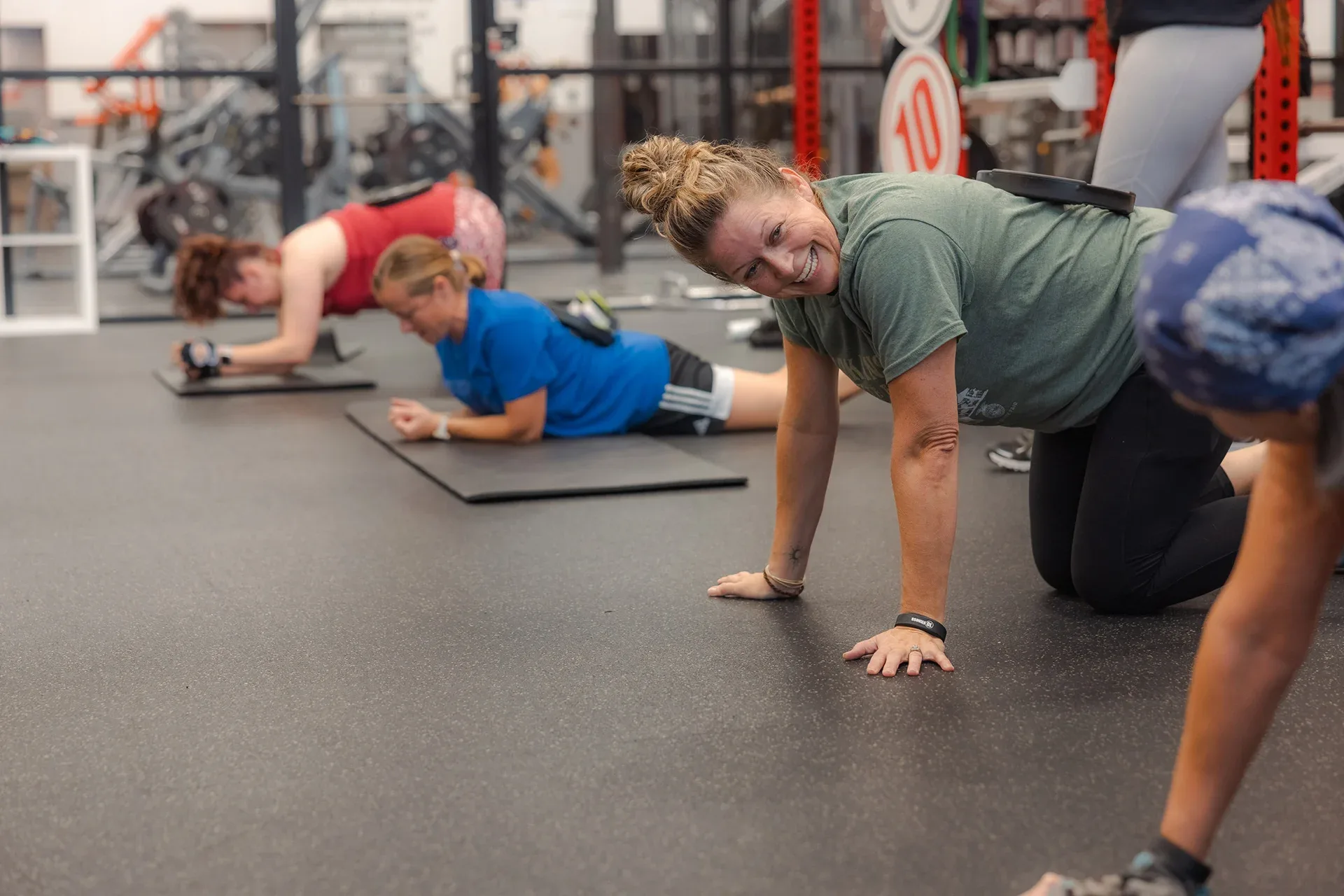
The first time you walk into a gym planning to lift weights, it’s easy to spend twenty minutes deciding where to start and leave without touching a barbell. That’s not a discipline problem. It’s a program problem. A beginner workout for women doesn’t need to be complicated: three days a week, movements that work your whole body, and a weight you can actually control while the form is still new. That’s the foundation. Every 10 Fitness location has the space and equipment to start exactly this way.
Jump to what you need:
-
#what-does-a-beginner-workout-for-women-actually-look-like
“>What a beginner plan actually looks like
-
#how-to-choose-the-right-starting-weight
“>How to pick your starting weight
-
#questions-our-trainers-hear-most
“>Common questions answered
Why Strength Training Is Worth Starting
Most people expect the payoff from strength training to show up in the mirror. What they don’t expect is that the first thing they notice, usually within the first week or two, is that they’re sleeping better than they have in years.
Not muscle definition. Not the number on the scale. Just a little more ease at the end of the day, and mornings that don’t feel like something you have to fight through. That’s usually the first signal that something has shifted.
Strength training gets sold as an appearance project. You’ve probably heard that framing a hundred times. But the changes that actually stick with people are quieter than that. You stop getting winded on stairs. You’re more stable carrying groceries through a parking lot. You feel more at home in your own body, which sounds vague until you experience it, and then it’s the most concrete thing in the world.
The cardiovascular data is genuinely striking too. https://www.health.harvard.edu/staying-healthy/strength-training-builds-more-than-muscles
” target=”_blank” rel=”noopener noreferrer”>Harvard Health identifies as the spots most vulnerable to fracture as women get older. Starting in your thirties matters. Starting in your sixties still matters. Bone responds to load at any age, full stop.
And then there’s the mental side, which almost nobody signs up for and almost everyone ends up mentioning. Stress has somewhere to go. A hard set of squats is a legitimate place to put a bad week. Most people feel the shift within the first few sessions, not some sweeping transformation, just a little more quiet in their head afterward. Your nervous system was built to work hard. When it actually gets that, it tends to settle down.
Before your first session, the Entrenamiento de fuerza para principiantes: ¿Por dónde empezar? ” target=”_blank” rel=”noopener noreferrer”>strength training for beginners guide
You don’t start out strong. You start out starting, and honestly, that’s the whole thing.
What Does a Beginner Workout for Women Actually Look Like?
Three days per week, something like Monday, Wednesday, and Friday, with rest days between. Those rest days aren’t wasted time. That’s when your muscles repair and get stronger.
The gym can feel like a foreign language when you’re new to it. Compound movements are a shortcut through that confusion. Squats, rows, and push-ups rope in your whole body at once, so instead of learning ten exercises to feel something, you learn three and feel everything. You’ll notice the difference faster than you expect.
"Progressive overload" gets thrown around constantly in fitness circles. It sounds like a system you’re supposed to master. It isn’t, really. It’s doing a little more than you did before: an extra rep, five more pounds, slowing a movement down so it actually challenges you. You’re not chasing that every single week. Some weeks you show up and repeat what you did. That’s fine. Progress lives in the months, not the moments.
Full-body training a few times a week is the smarter setup before you start splitting things by body part. Your muscles are still learning coordination, your joints are adapting, and your nervous system is figuring out what "effort" means. Spreading that work across your whole body gives all of it a chance to catch up together. These Planes de entrenamiento para rutinas: ¿por dónde empezar? ” target=”_blank” rel=”noopener noreferrer”>beginner workout plans
A 3-Day Beginner Workout Plan
Day 1: Lower Body
Goblet squat: 3 sets of 10 Grab a single dumbbell and hold it vertically at your chest, both hands cupped around the top end. Sit back and down like there’s a chair behind you, chest proud, knees spreading wide over your toes. Most people are surprised how quickly this teaches their body what a proper squat actually feels like.
Reverse lunge: 3 sets of 10 per side From standing, step one foot straight back and let your back knee drop toward the floor. Your front heel does the work to bring you back up. If forward lunges have ever bothered your knees, this version tends to feel considerably kinder on the joint.
Glute bridge: 3 sets of 12 Lie on your back with your knees bent and feet flat on the floor. Dig your heels in, then drive your hips up until your shoulders, hips, and knees form one straight line. Hold that top position for a beat before lowering back down. Your glutes and hamstrings will let you know they were there.
Romanian deadlift (dumbbell): 3 sets of 10 Stand with the dumbbells resting against the front of your thighs. Hinge at the hips, not the waist, and let the weights travel down toward your shins while your back stays flat. That hamstring tension you feel partway down? That’s the signal. Drive your hips forward and stand back up tall.
Day 2: Upper Body
Dumbbell row: 3 sets of 10 per side Rest one hand and knee on a bench, then let the dumbbell hang from your free arm. Pull it up toward your hip, leading with your elbow. That small shift makes a real difference in how much your back actually works versus your hand.
Push-up (or incline push-up): 3 sets of 8–10 A lot of people treat the incline version like it’s cheating. It’s not. Hands on a bench or step, body in one straight line from head to heels, chest lowering toward the surface. Same movement, less load. Start where your form is actually good.
Dumbbell shoulder press: 3 sets of 10 Start with a dumbbell at each shoulder, palms facing forward. Press both straight overhead until your arms are fully extended, then lower slow. If your lower back starts to arch on the press, brace your core a little more. A small amount of tension there goes a long way.
Dumbbell bicep curl: 3 sets of 12 Curl the weights up to your shoulders. The part most people skip: control the descent. Fight gravity all the way back to the bottom. By the last few reps, you’ll feel exactly what that difference makes.
Day 3: Full Body
Goblet squat: 3 sets of 10. You’ve done this movement twice already. This time, pay attention to whether it’s starting to click: depth coming easier, less thinking about where your elbows go, reps that feel more controlled than the ones before.
Dumbbell row: 3 sets of 10 per side. Same as Day 2. By the end of the week, your body starts to remember the setup, the grip, where to brace. Let it.
Push-up (or incline push-up): 3 sets of 8–10. Stick with the variation that worked on Day 2. If you’re feeling ready, try dropping one level closer to the floor. You’ll know quickly if it’s too soon.
Glute bridge: 3 sets of 12. Same as Day 1, with one addition: pause at the top for a full second before lowering. That pause is where the work happens.
Plank: 3 rounds of 20–30 seconds. Forearm plank, hips level, just breathe. Planks have a way of humbling people who expected them to be easy, and that’s completely normal. Twenty seconds can feel surprisingly long when you’re new to it. Add a few seconds each week.
Cómo elegir el peso inicial adecuado
Start lighter than you think you need to. That’s not a disclaimer. That’s the actual advice.
Your last two reps should take real effort, but your form should look basically the same as rep one did. If your back starts rounding, your shoulders creep up, or something feels off, drop the weight. Not a judgment call. Just the rule.
On the flip side, if you finish a set and those last two reps felt easy, go up a little next time. Small jumps. Five pounds, sometimes less.
Bodies vary too much for anyone to hand you a specific number on day one. Getting comfortable with the movement matters more than moving fast. Once the form is there, adding weight is easy.
Where to Find a Beginner Workout Near You
If you’re in the Little Rock area,
” target=”_blank” rel=”noopener noreferrer”>10 Fitness Cantrell
Gym intimidation is real, and the
” target=”_blank” rel=”noopener noreferrer”>Women’s Room
” target=”_blank” rel=”noopener noreferrer”>Find a 10 Fitness near you
¿No estás seguro de si estás haciendo bien los movimientos?
That’s what
” target=”_blank” rel=”noopener noreferrer”>personal training
Las preguntas más frecuentes que reciben nuestros formadores
How many days a week should a beginner work out?
Two to three days is the right range when you’re starting out. The days you’re not in the gym aren’t days off from progress. That’s actually when your muscles repair and get a little stronger. Piling on more sessions before your body has adapted usually just means more soreness and a higher chance of burning out before the habit sticks.
Will lifting weights make me bulky?
Fair question, and one we get from almost everyone who walks in nervous about the weight room. Getting genuinely bulky takes years of dedicated lifting, eating way more than most people want to, and a level of intentional effort that doesn’t happen by accident. What strength training will actually do for you is make real life feel easier: carrying groceries, climbing stairs, keeping up with your kids. You’ll also build stability and endurance that cardio on its own just doesn’t deliver. Honestly, the members who end up loving the weight floor the most are usually the ones who put it off the longest.
What should I eat before a workout?
Something small with a little carbohydrate and protein, about 30 to 60 minutes before you go in. A banana with peanut butter works. Greek yogurt with fruit works. You don’t need a pre-workout stack. Just eat something that won’t sit heavy.
How long until I see results?
The changes you feel tend to arrive before the ones you can see. Better sleep, steadier energy, a mood that holds through the afternoon. Most people notice that within the first two to four weeks. The visible changes usually take six to eight weeks of consistent showing up. Consistent beats intense every time.
Your First Step Starts Here
Walking in already knowing the right move matters more than standing at the rack and second-guessing yourself.
Why wait? Every day you put it off is a day you don’t get back. 10 Fitness is built for Every Body, including yours, exactly as it is right now.
” target=”_blank” rel=”noopener noreferrer”>Find your nearest 10 Fitness